 StrenuousStrenuous7–9 hours a day · Above 5,000 m, with a passRemote routes, a high pass to cross on a fixed day, and camping where there are no lodges. Previous multi-day trekking at altitude is a condition of joining.
Everest Base Camp Trek
Fourteen days from Kathmandu to the foot of the Khumbu Icefall and back, with two full acclimatisation days, a sunrise on Kala Patthar and a crew from the valley you are walking through.
from$1,490
per person, twin share
- 14 days
- Max 5,545 m
- ChallengingChallenging6–7 hours a day · 4,500–5,600 mConsecutive days at altitude, cold nights and a pre-dawn start or two. You need to arrive fit rather than plan to get fit on the trail.
Adventure Milestone Treks Pvt. Ltd.
Everest Base Camp Trek
Fourteen days from Kathmandu to the foot of the Khumbu Icefall and back, with two full acclimatisation days, a sunrise on Kala Patthar and a crew from the valley you are walking through.
14 days · Challenging · maximum altitude 5,545 m · from $1,490 per person, twin share
P.O. Box 12502, Thamel, Kathmandu, Nepal · +977 9851085456 · info@adventuremilestone.com
Overview
Everest Base Camp is the most walked trail in the Himalaya and still the one that surprises people. You are not climbing Everest; you are walking to the place climbers leave from, through eight days of Sherpa country that is worth the flight on its own: suspension bridges over the Dudh Koshi, the monastery at Tengboche, yak trains, potato fields at 4,400 m, and a horizon that keeps producing 8,000 m peaks you had not thought to expect.
Our version runs over fourteen days rather than the twelve you will see quoted elsewhere, and the extra two are not padding. They are a full acclimatisation day at Namche and another at Dingboche, with a climb-high-sleep-low hike on each. It is the single biggest thing that separates a trek people finish from one they abandon at Lobuche with a headache, and we would rather sell you the fortnight honestly than sell you the shorter trip and hope.
You walk with a government-licensed guide born in the Khumbu, one porter for every two trekkers, and a group that never exceeds twelve. Your guide carries a pulse oximeter and takes a reading twice a day. The Lukla flight, the Ramechhap transfer in peak season, both national park permits and every meal on the trail are in the price on this page. There is no kitty, no local payment and no surcharge waiting for you at the briefing.
Trip facts
- Duration
- 14 days13 nights
- Maximum altitude
- 5,545 mKala Patthar
- Group size
- 2–12Private departures available
- Best season
- Mar–Mayand Sep–Nov
- Start and finish
- KathmanduAirport transfers included
- Accommodation
- 3 hotel · 10 teahouseTwin share throughout
- Meals
- 13 B · 11 L · 13 DOrdered from the full menu
- Transport
- Lukla flightsPrivate vehicle in the valley
- Permits
- Both includedSagarmatha NP · Khumbu Rural Municipality
- Distance on foot
- ≈ 120 kmLukla to Lukla, 11 walking days
- Crew ratio
- 1 porter : 2Second guide from eight travellers
Trip highlights
- Stand at Everest Base Camp, 5,364 m, at the foot of the Khumbu Icefall
- Sunrise from Kala Patthar, 5,545 m, the clearest view of Everest anywhere on foot
- Two full acclimatisation days built in, at Namche Bazaar and Dingboche
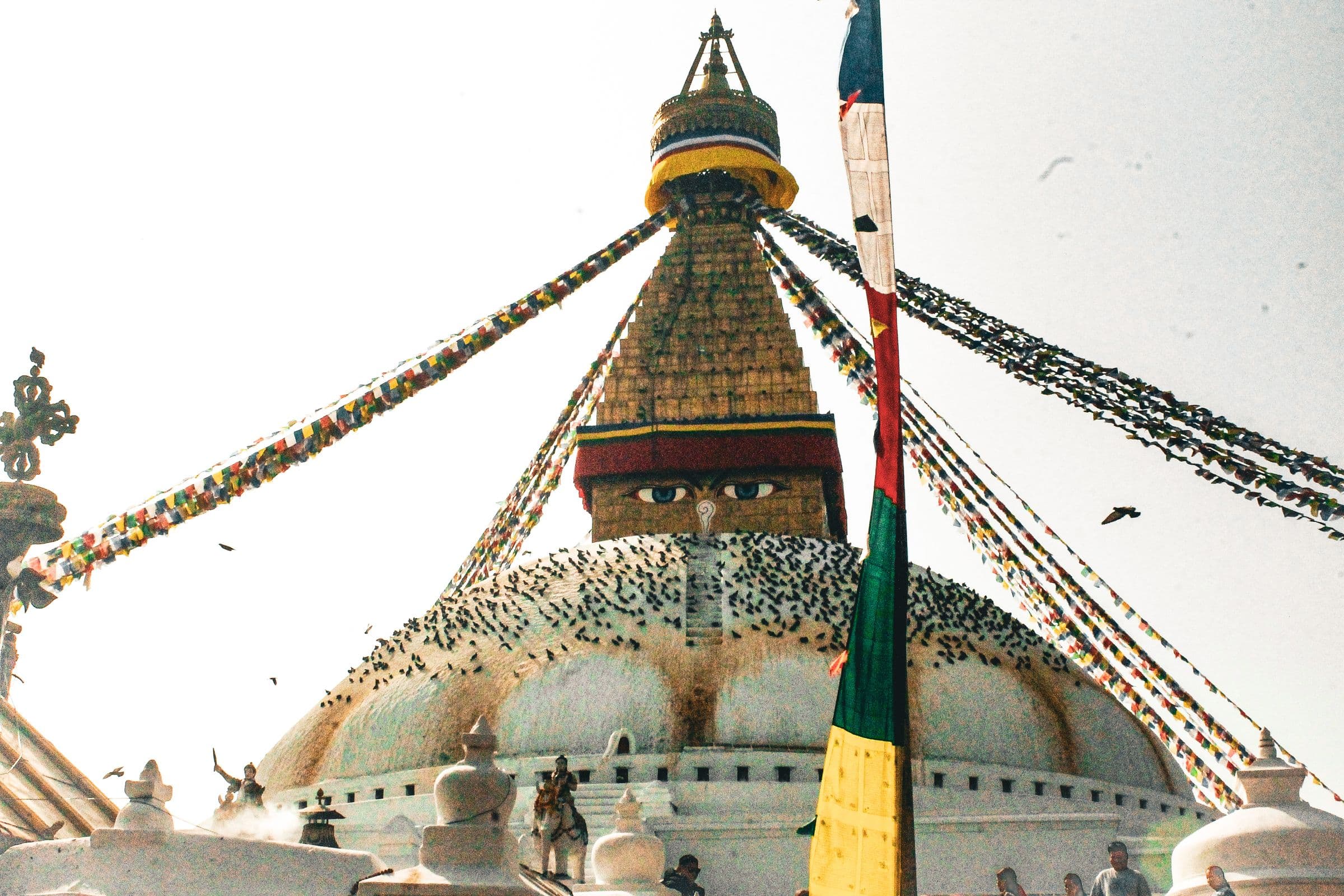
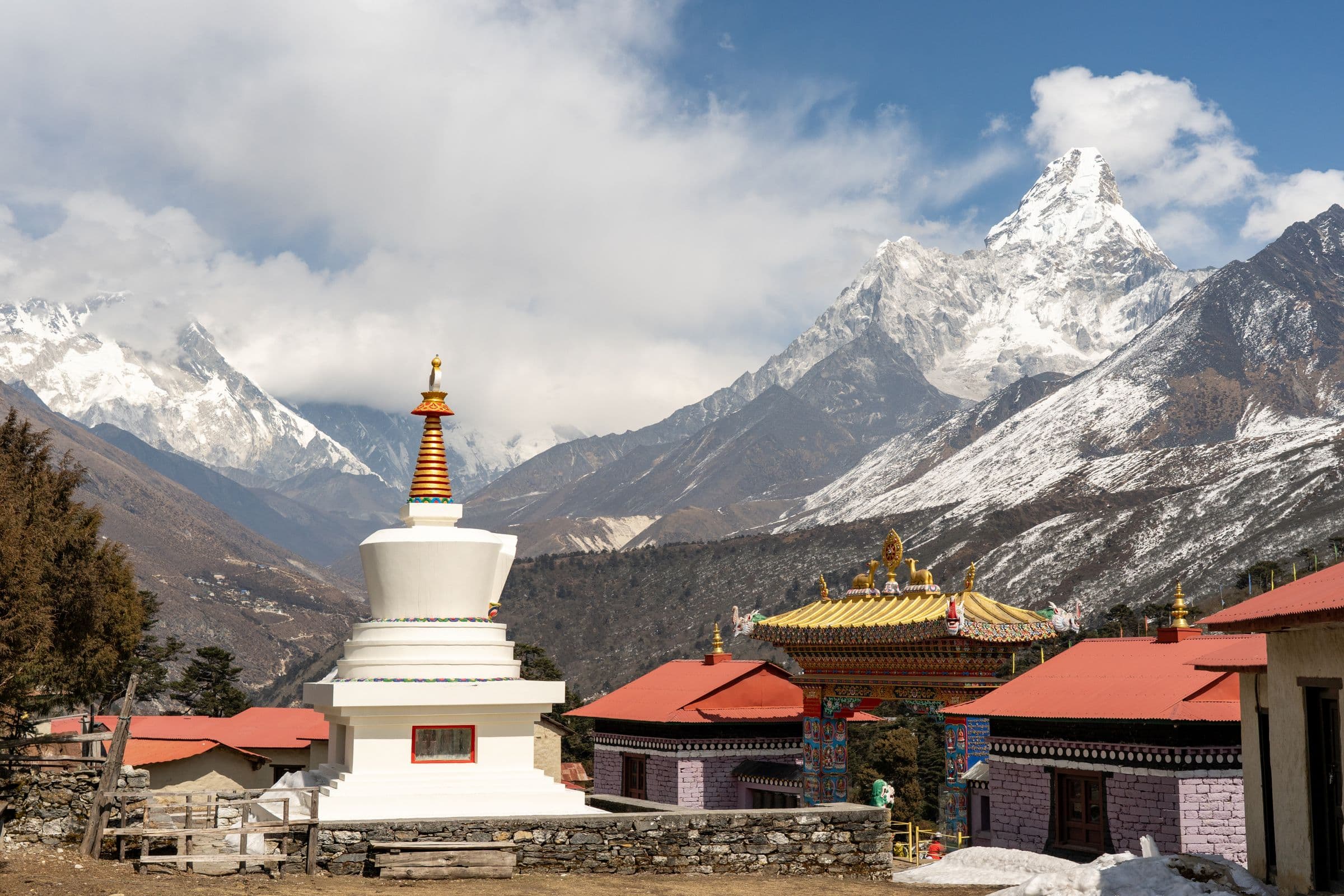
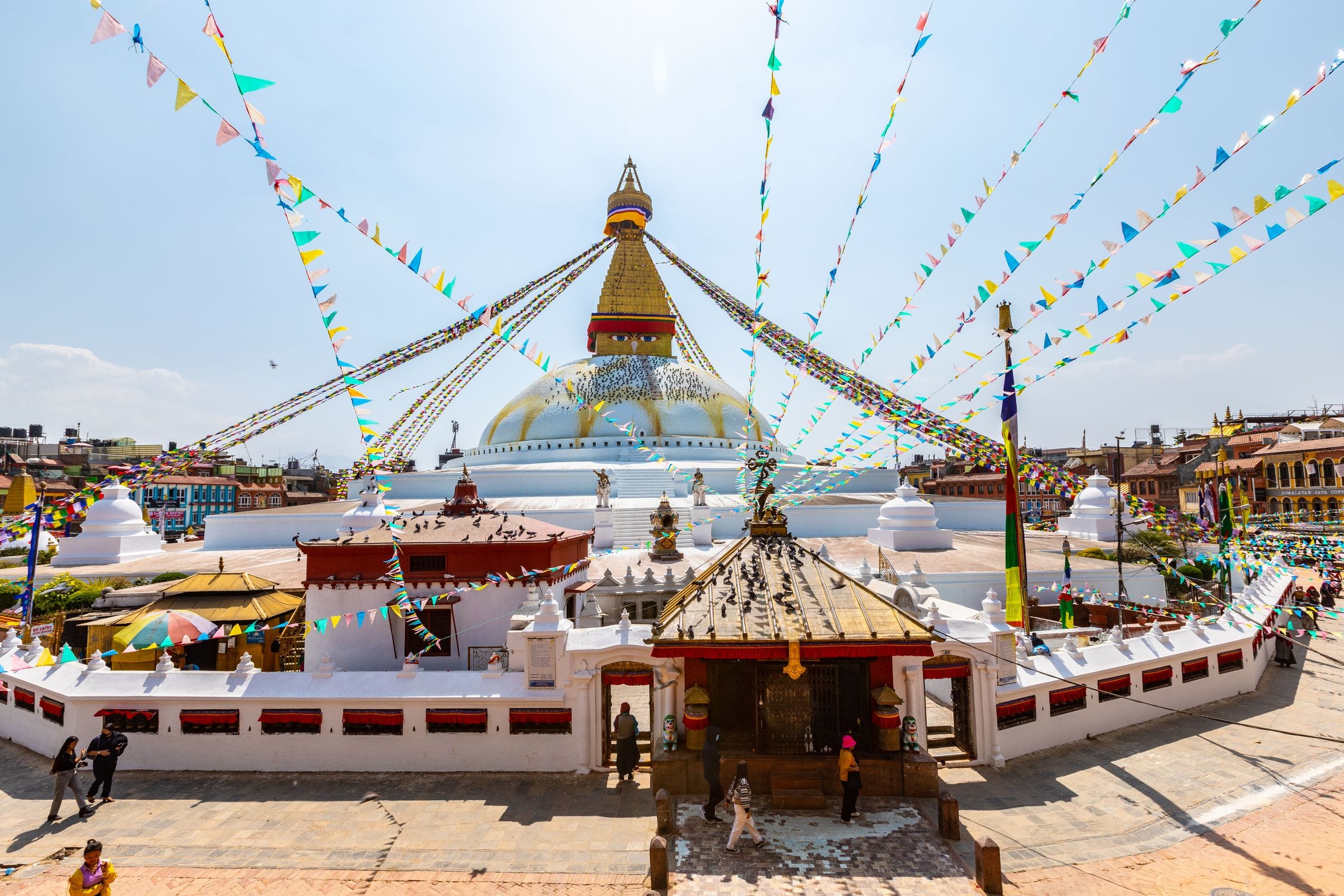
- Afternoon puja at Tengboche, the largest monastery in the Everest region
- Ama Dablam, Lhotse, Nuptse, Pumori and Makalu from the trail itself
- Namche Bazaar: Saturday market, bakeries, museums and a genuinely hot shower
- A Khumbu-born guide, a 1:2 porter ratio, and every crew member insured
The itinerary
Download PDFSleeping altitude, walking time, meals and lodging for every day.
Altitude profile
- Sleeping altitude
- Day's high point
Days 4 and 7 are acclimatisation days: you climb higher in the day and come back down to sleep.
Everest Base Camp Trek: day by day
14 days
Day 1Arrive in Kathmandu1,400 mNo walking
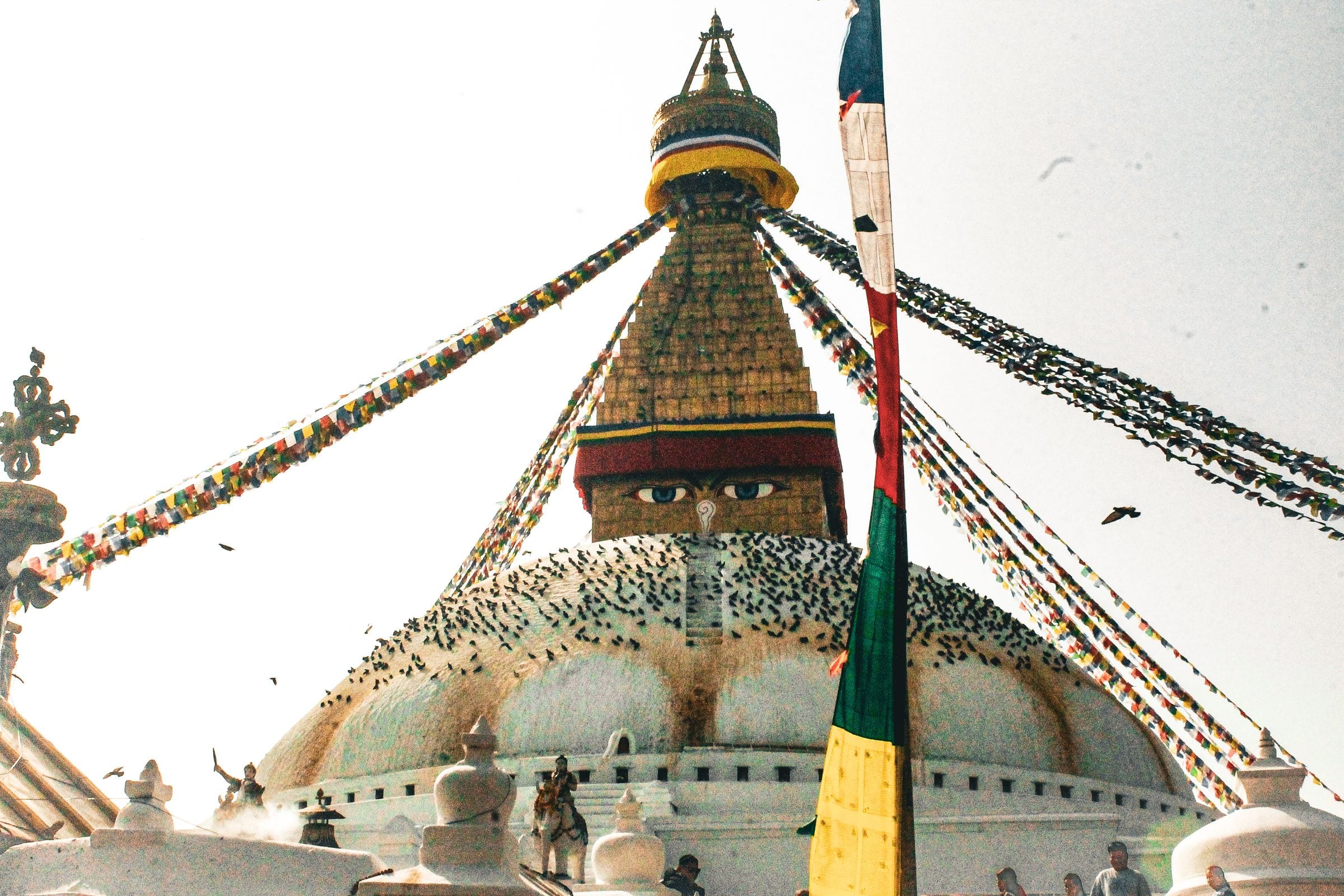
Someone from our office meets you inside the arrivals hall at Tribhuvan International and drives you the twenty minutes into Thamel. The rest of the day is yours to sleep off the flight. At 4 pm we run the trip briefing over tea: we check your insurance certificate, hand out the duffel, down jacket and sleeping bag, and go through the kit you have brought piece by piece so anything missing can be bought the same evening, two streets away.
- Private airport pick-up, any arrival time
- 4 pm briefing, kit check and gear issue
- Welcome dinner in a Newari courtyard restaurant
 Walking timeNo walkingSleeping altitude1,400 mDistanceAirport transferMealsBBreakfast not includedLLunch not includedDDinner includedHotelHotel Thamel Park, twin share
Day 2Fly to Lukla, trek to Phakding2,610 m· high 2,840 m35 min flight · 3–4 hrs walking
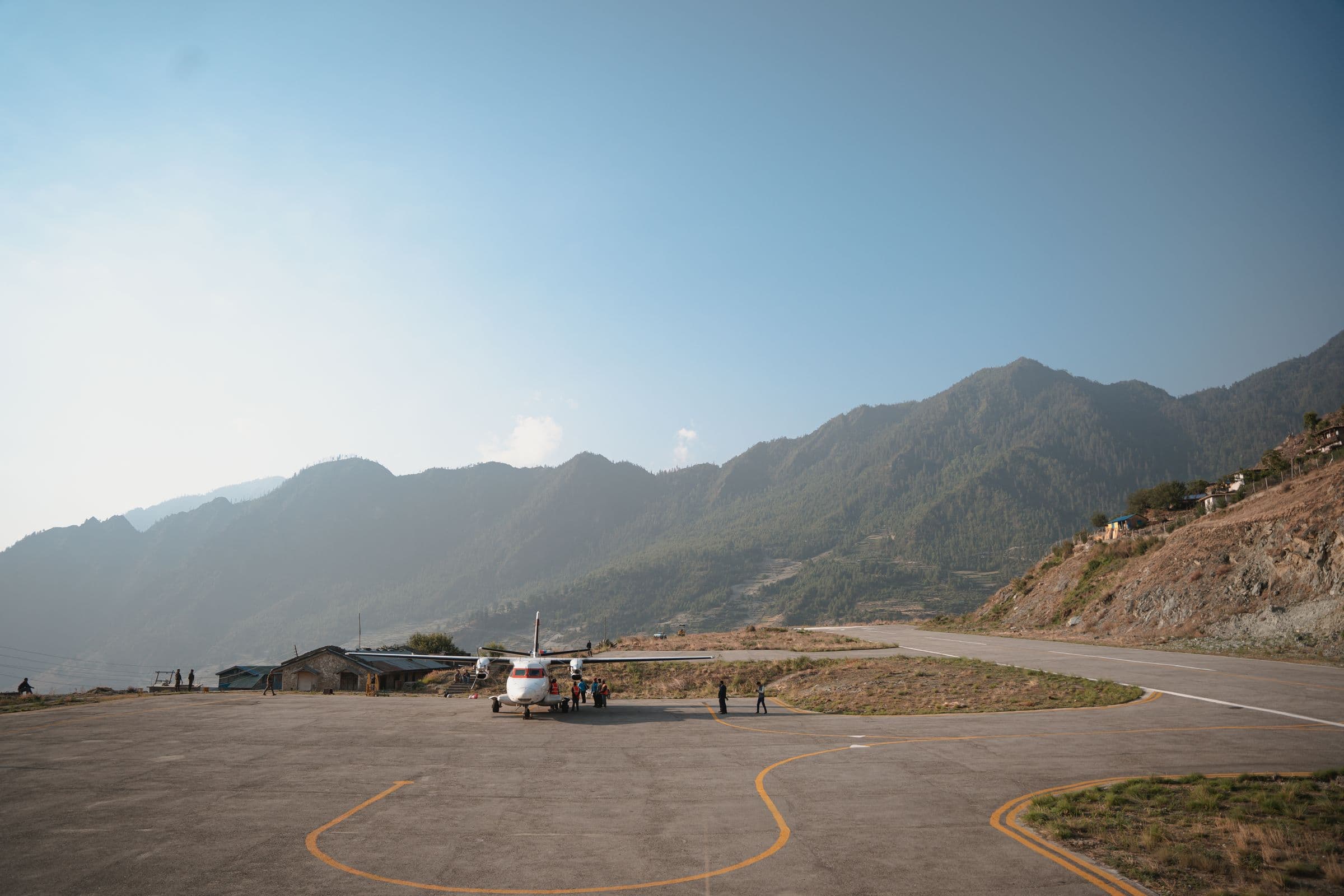
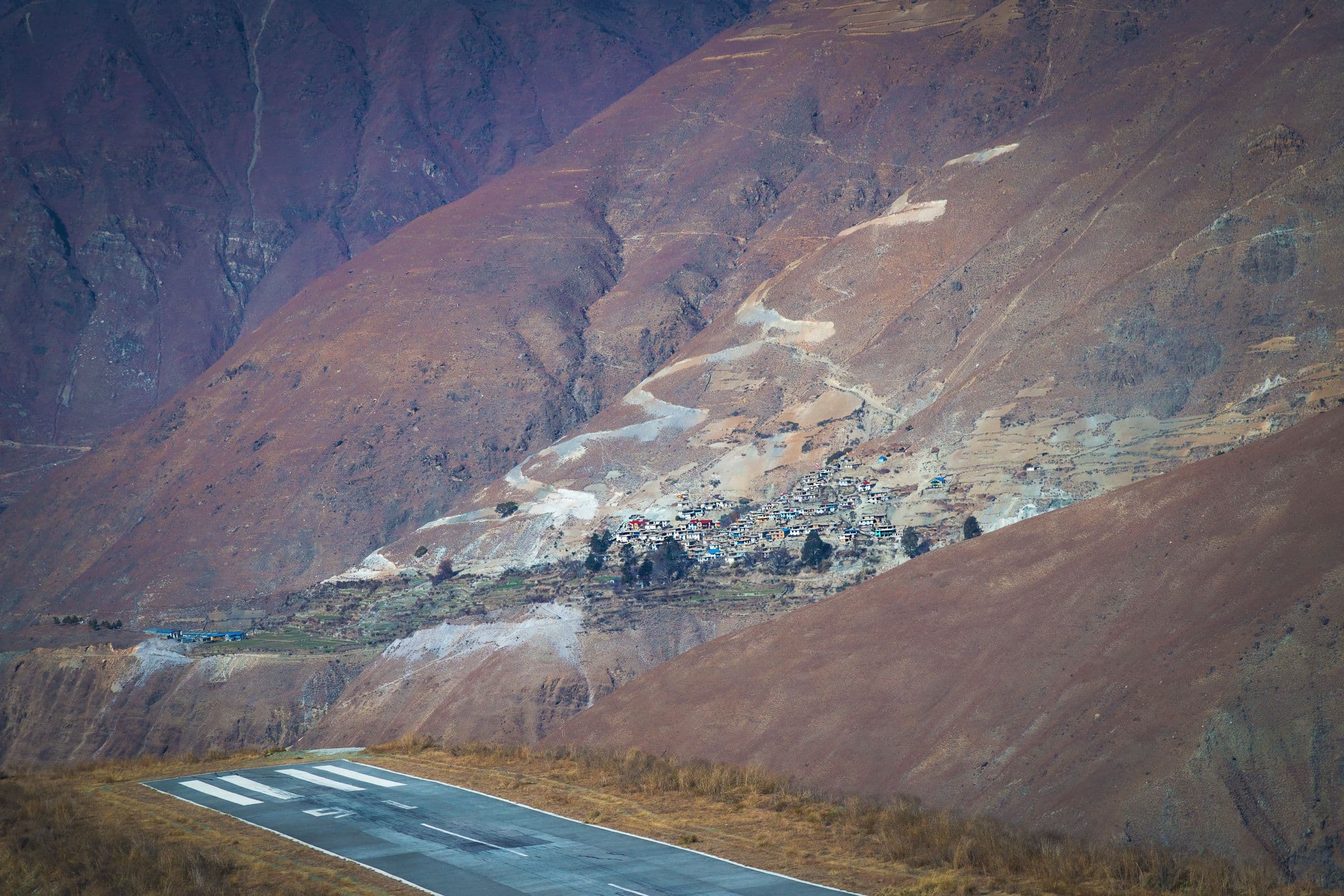
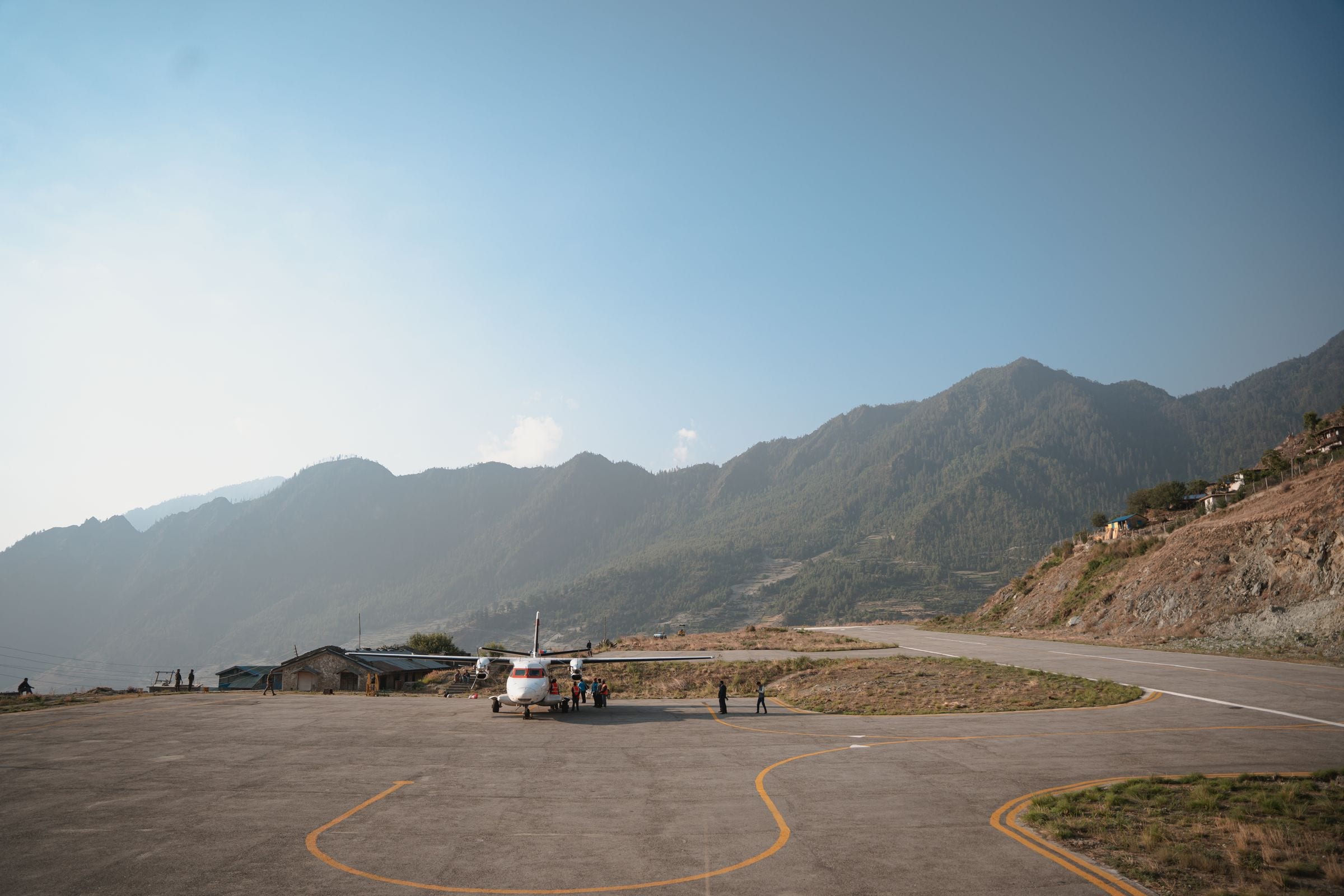
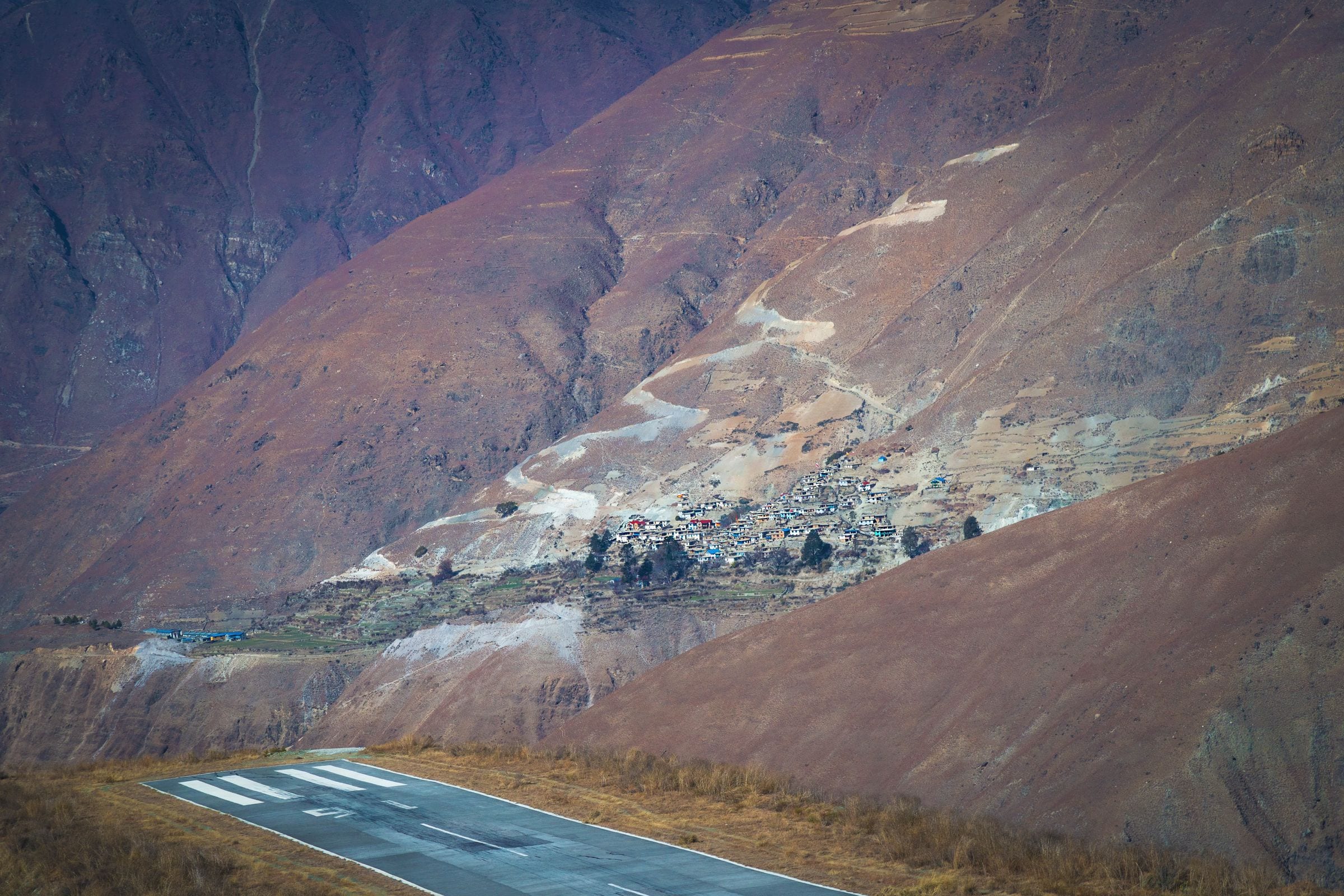
An early transfer to the domestic terminal, or, in the October and April peaks, a four-hour pre-dawn drive to Ramechhap, which we build into the price rather than bill you for later. The flight into Tenzing–Hillary Airport is thirty-five minutes of Himalaya through the left-hand windows and a landing on a runway that tilts uphill. You meet the porters over tea, then the trail drops gently through Ghat to Phakding beside the grey-green Dudh Koshi. A deliberately short first day: you have just gained 1,400 m by air.
- Peak-season Ramechhap transfer included, not surcharged
- Porters and crew join here
- Net descent on day one, by design
 Walking time35 min flight · 3–4 hrs walkingSleeping altitude2,610 mDistance8 kmMealsBBreakfast includedLLunch includedDDinner includedTeahouseTeahouse, private twin room
Day 3Phakding to Namche Bazaar3,440 m6–7 hrs
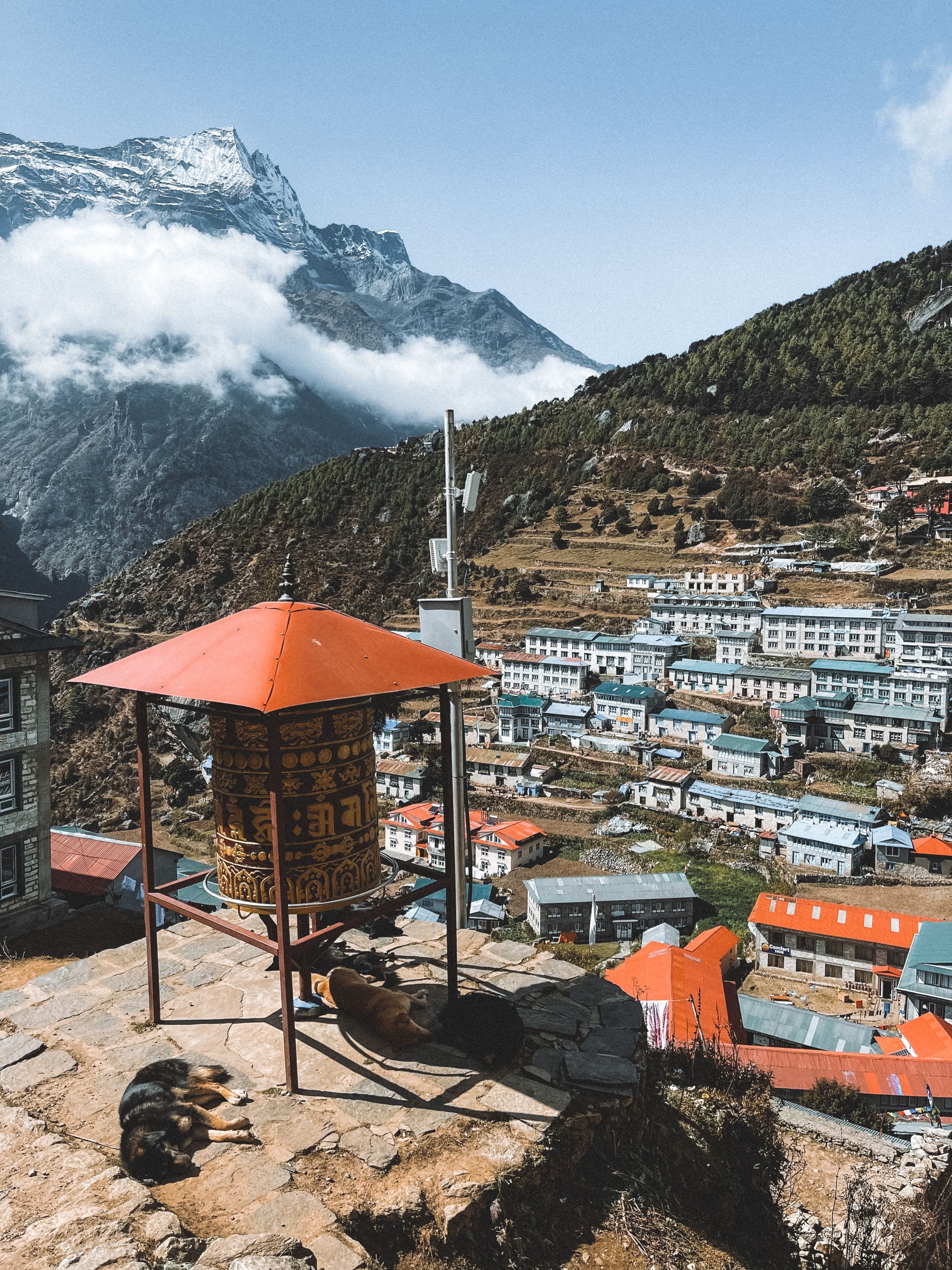
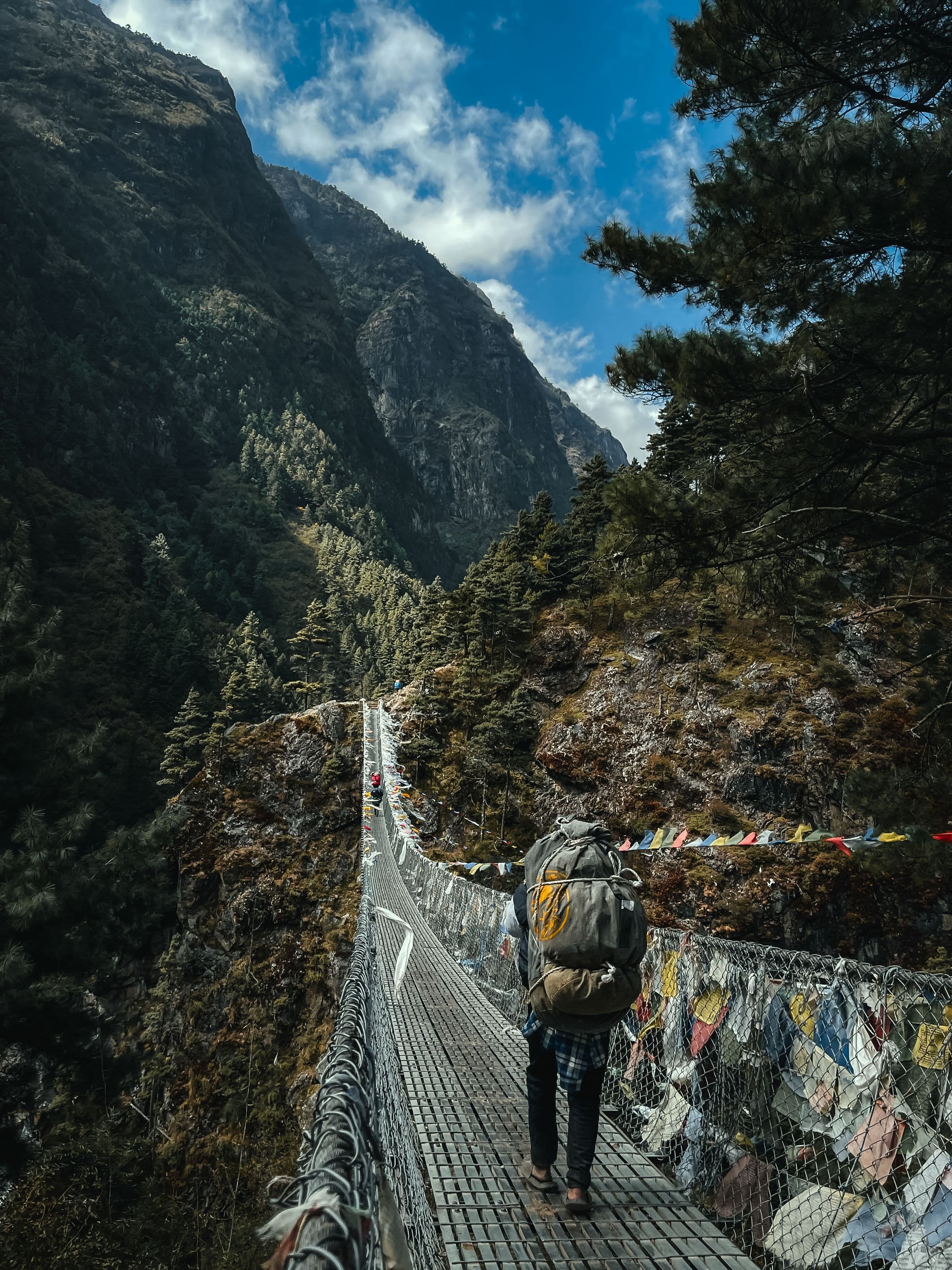
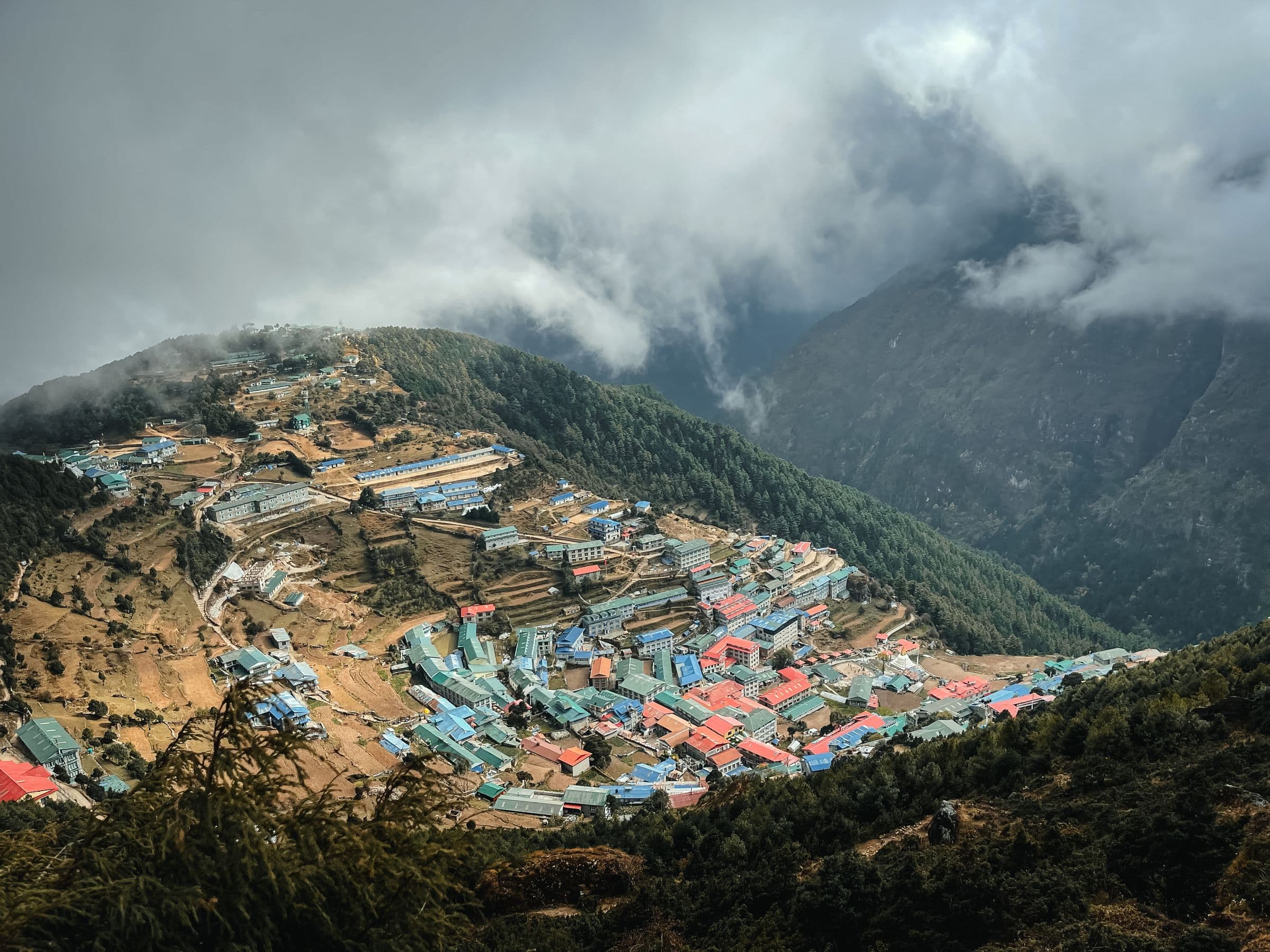
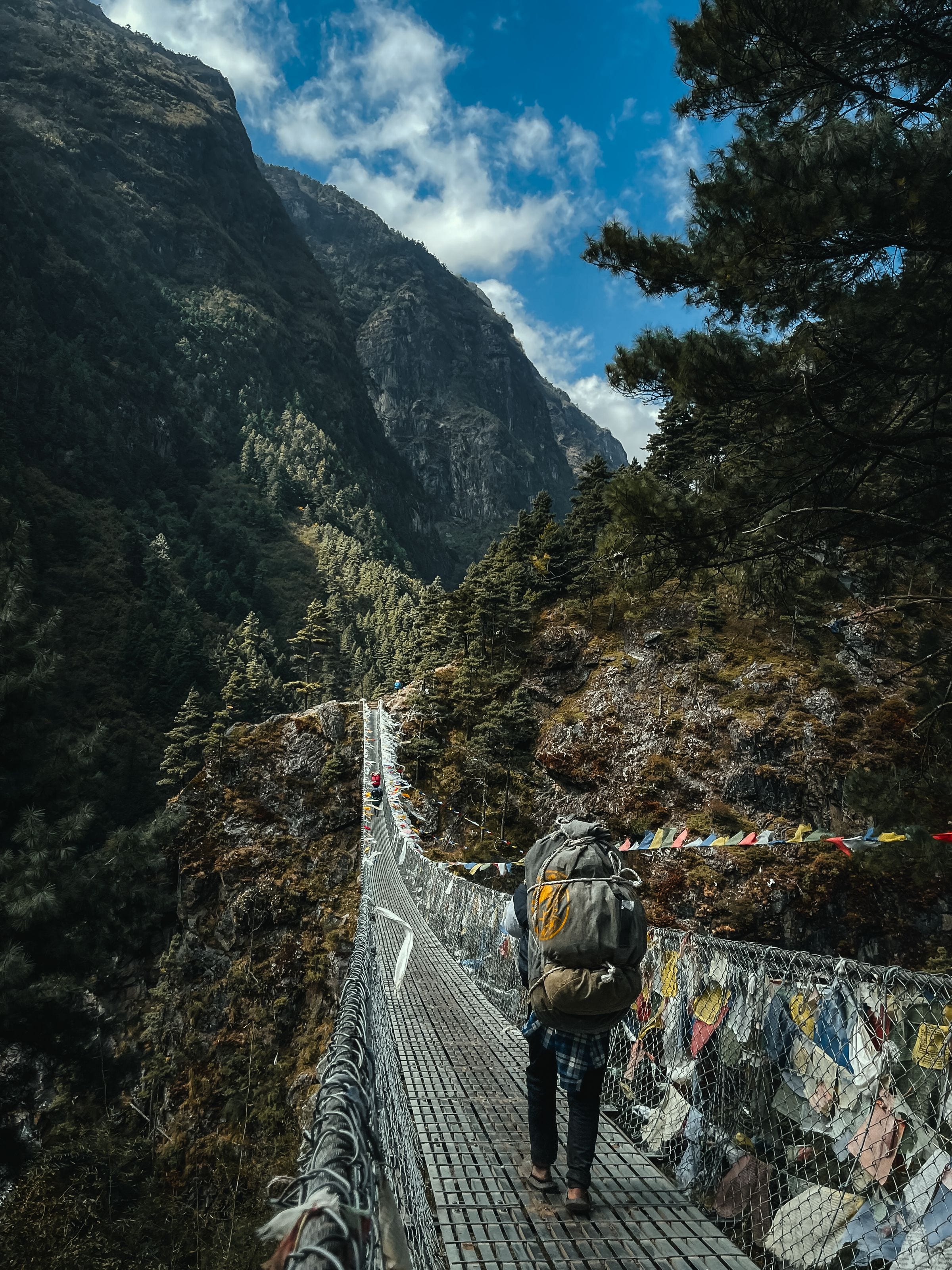
The day everyone remembers. Five suspension bridges, the last of them the Hillary Bridge hung 125 m above the confluence, then the long switchbacked climb through blue pine into Sagarmatha National Park. Halfway up the hill the trees open and Everest appears for the first time, a black triangle behind the Nuptse wall. Namche is a horseshoe of painted lodges stacked up a natural amphitheatre: bakeries, gear shops, an Irish bar and a Saturday market that pulls traders up from the lowlands.
- Park entry and permit checks at Monjo
- First view of Everest, weather permitting
- 830 m of ascent: we walk it slowly and stop often
 Walking time6–7 hrsSleeping altitude3,440 mDistance10.5 kmMealsBBreakfast includedLLunch includedDDinner includedTeahouseTeahouse, en-suite twin room
Day 4Acclimatisation day at Namche3,440 m· high 3,880 m3–4 hrs
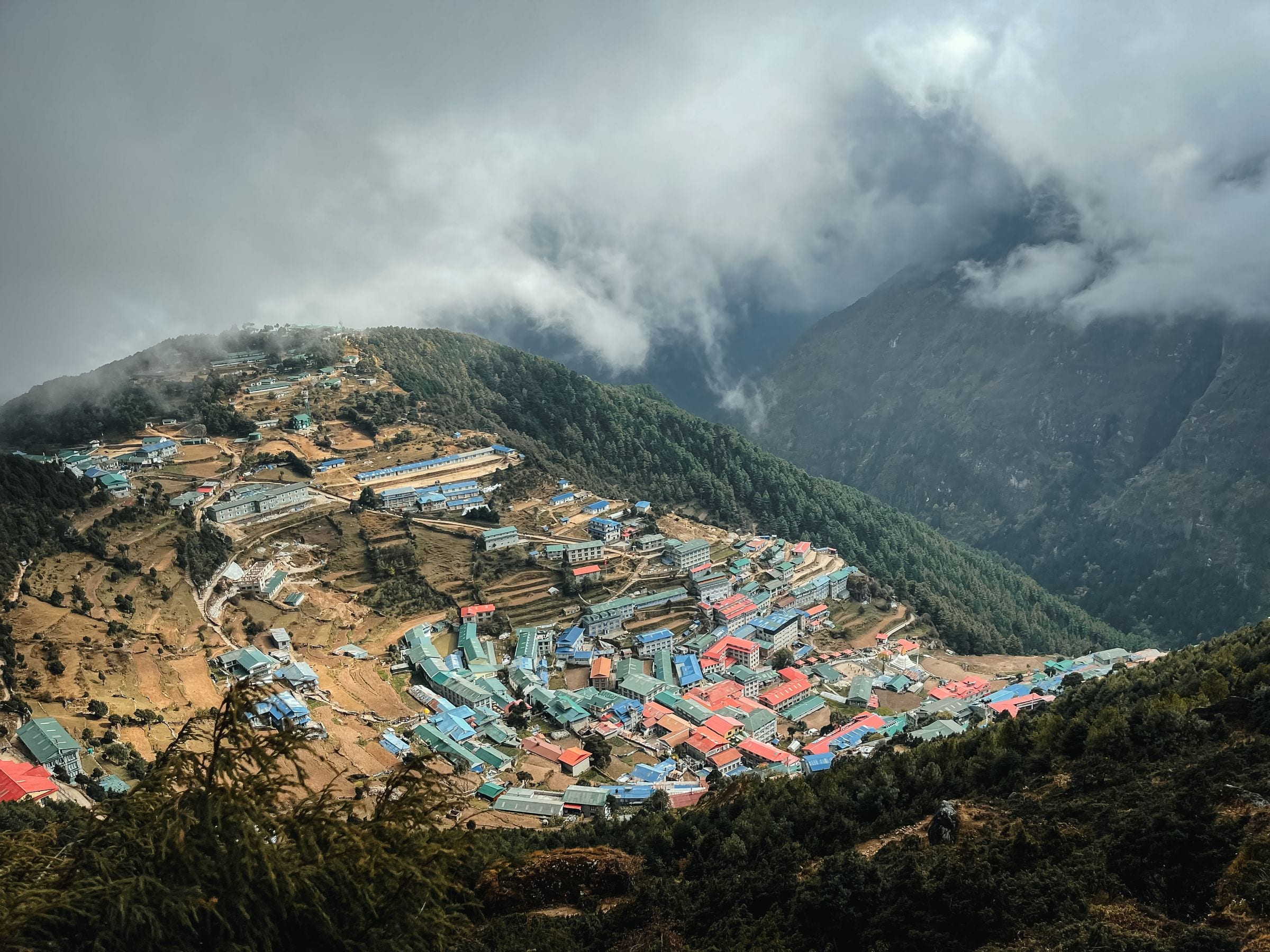
Climb high, sleep low. After breakfast we walk up to the Everest View Hotel at 3,880 m for coffee with Everest, Lhotse and Ama Dablam lined up across the valley, then loop down through Khumjung, past the Hillary school and the monastery with its disputed yeti scalp, and back into Namche by mid-afternoon. The rest of the day is free for the Sherpa Culture Museum, Sagarmatha Next, a hot shower and the last reliable ATM on the route.
- Acclimatisation hike to 3,880 m, then descend to sleep
- Sagarmatha Next and Sherpa Culture Museum included
- Last dependable ATM and pharmacy on the trail
 Walking time3–4 hrsSleeping altitude3,440 mDistance5 kmMealsBBreakfast includedLLunch includedDDinner includedTeahouseTeahouse, en-suite twin room
Day 5Namche Bazaar to Tengboche3,860 m5–6 hrs
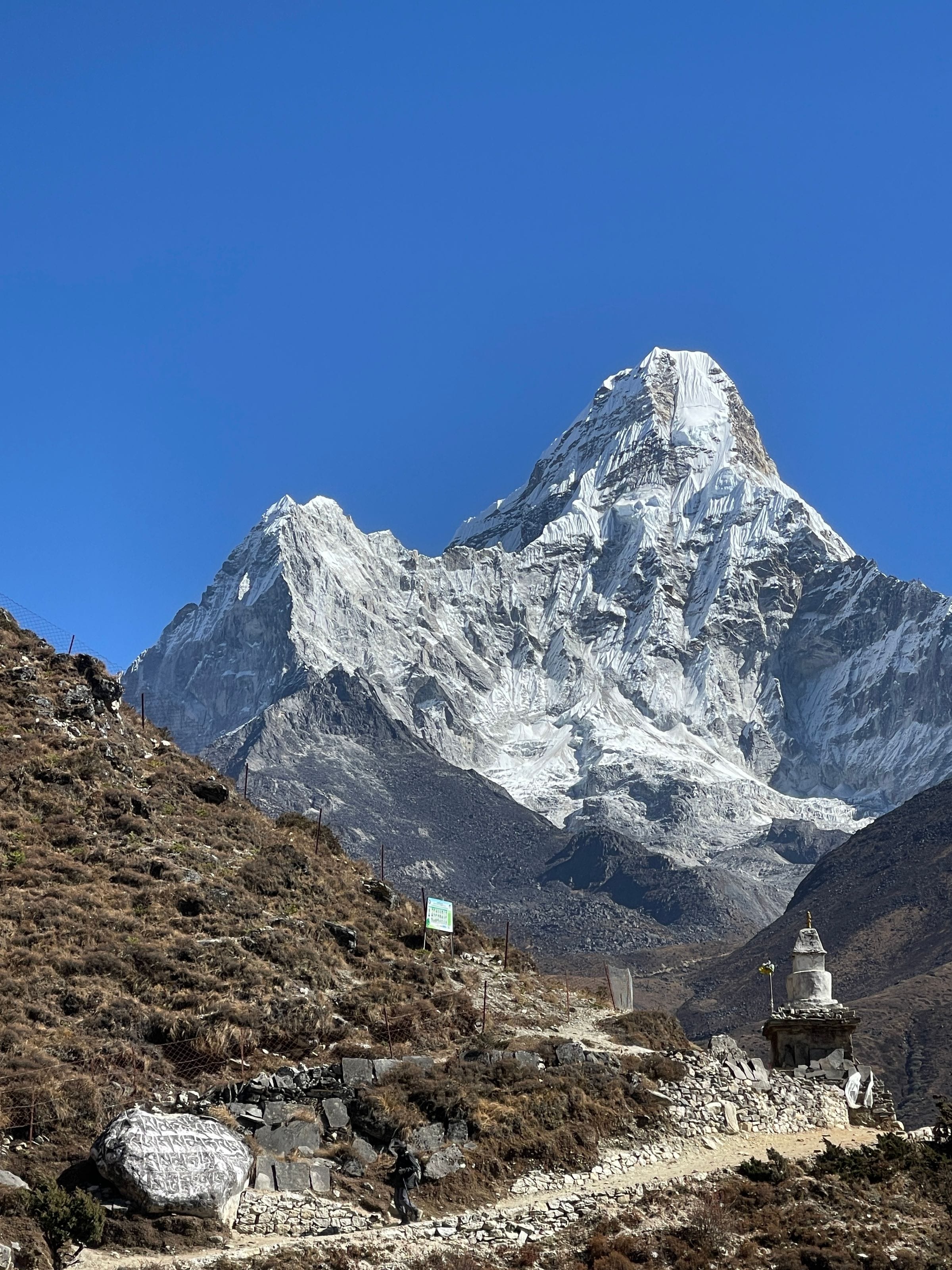
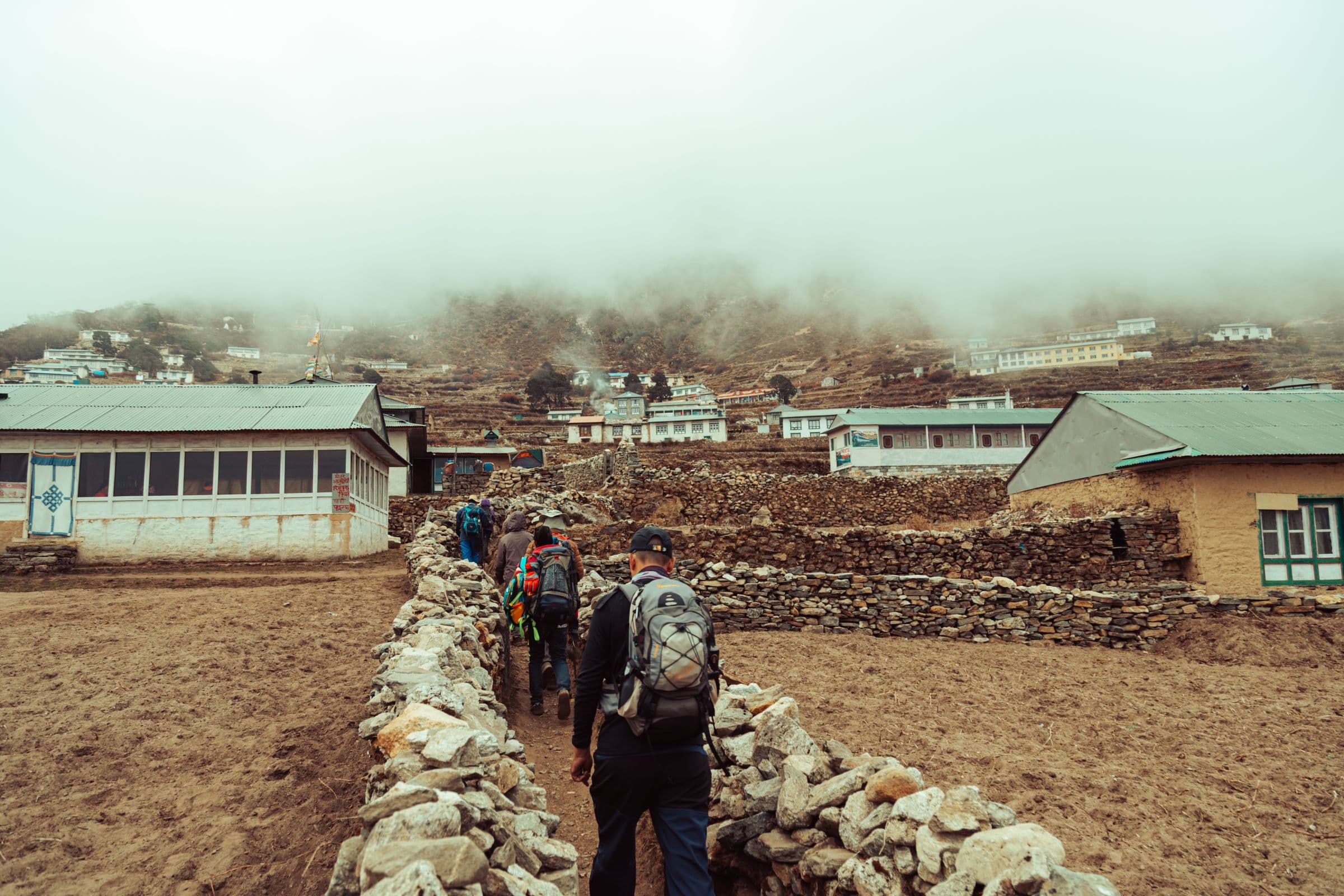
A level contour path with Ama Dablam ahead of you for two hours, the most photographed stretch of trail in Nepal, before a steep drop to the river at Phunki Tenga and a 600 m climb through rhododendron to the saddle. Tengboche is the spiritual centre of the Khumbu: a monastery on a ridge with Everest, Nuptse, Lhotse and Ama Dablam standing around it. We time our arrival for the 3 pm puja, and the monks let visitors sit at the back.
- Afternoon puja at Tengboche monastery
- Ama Dablam in view for most of the morning
- Cold nights here: the down jacket earns its place
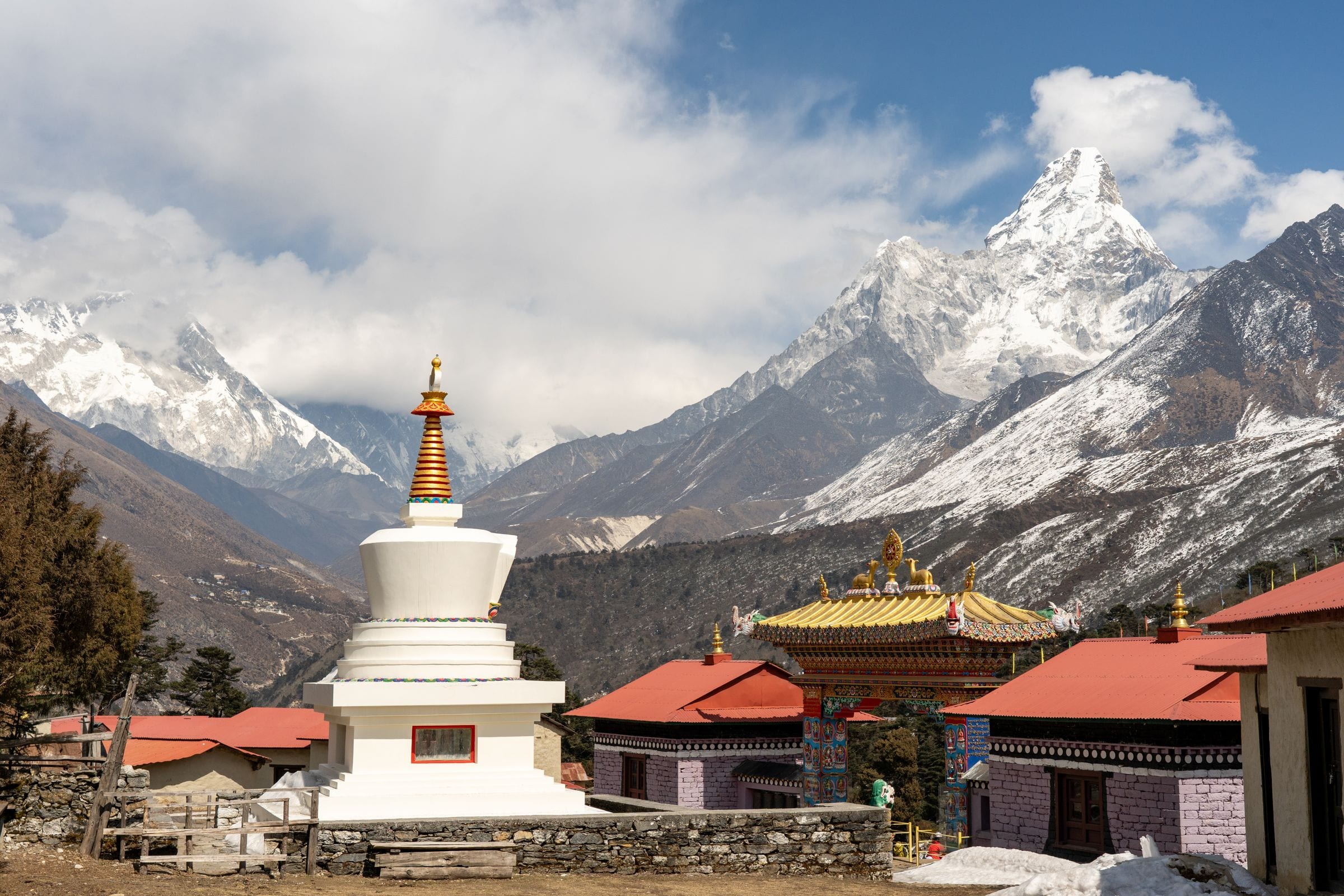 Walking time5–6 hrsSleeping altitude3,860 mDistance9.5 kmMealsBBreakfast includedLLunch includedDDinner includedTeahouseTeahouse, twin share
Day 6Tengboche to Dingboche4,410 m5–6 hrs
Through the last of the birch and juniper at Deboche, past the long mani wall at Pangboche and its 15th-century gompa, then over the Imja Khola and up into open country. The treeline ends somewhere before lunch and does not come back. Dingboche is a scatter of stone-walled potato fields at 4,410 m with the south face of Lhotse closing the head of the valley. You will notice the air here.
- Optional detour to Pangboche's old monastery
- Above the treeline from today onward
- First oximeter readings taken at dinner
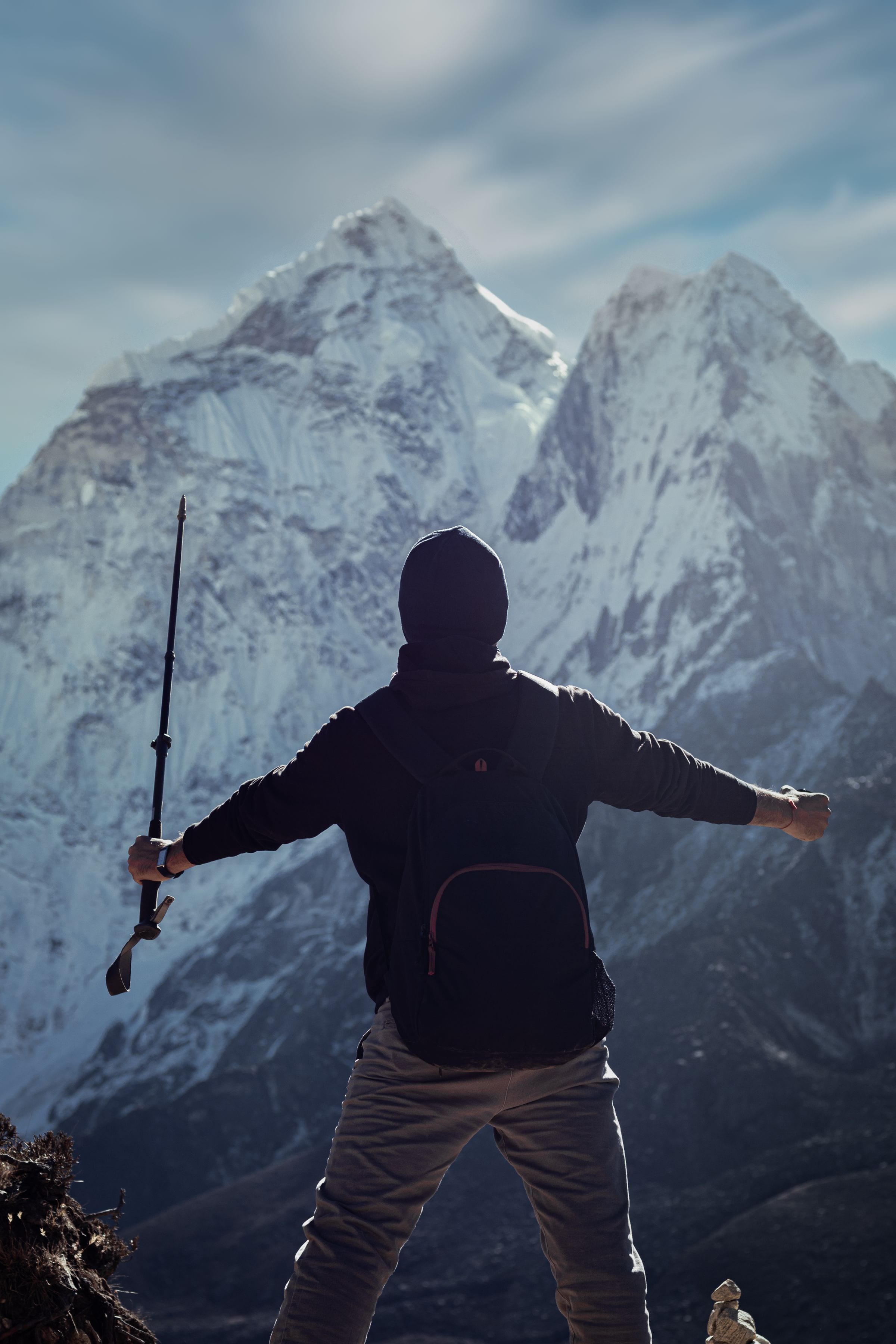 Walking time5–6 hrsSleeping altitude4,410 mDistance11 kmMealsBBreakfast includedLLunch includedDDinner includedTeahouseTeahouse, twin share
Day 7Acclimatisation day at Dingboche4,410 m· high 5,083 m4–5 hrs
The second built-in rest day, and the one that decides how the rest of the trek goes. We climb the ridge behind the village to Nangkartshang at 5,083 m, steep, slow and entirely optional, for a panorama that takes in Makalu, the world's fifth-highest mountain, over the Chhukung valley. Back down for a long lunch and an afternoon of doing very little, which at this height is real work.
- Nangkartshang ridge, 5,083 m, your first time above 5,000 m
- Anyone not feeling right stays low with an assistant guide
- Afternoon rest is part of the plan, not a wasted half-day
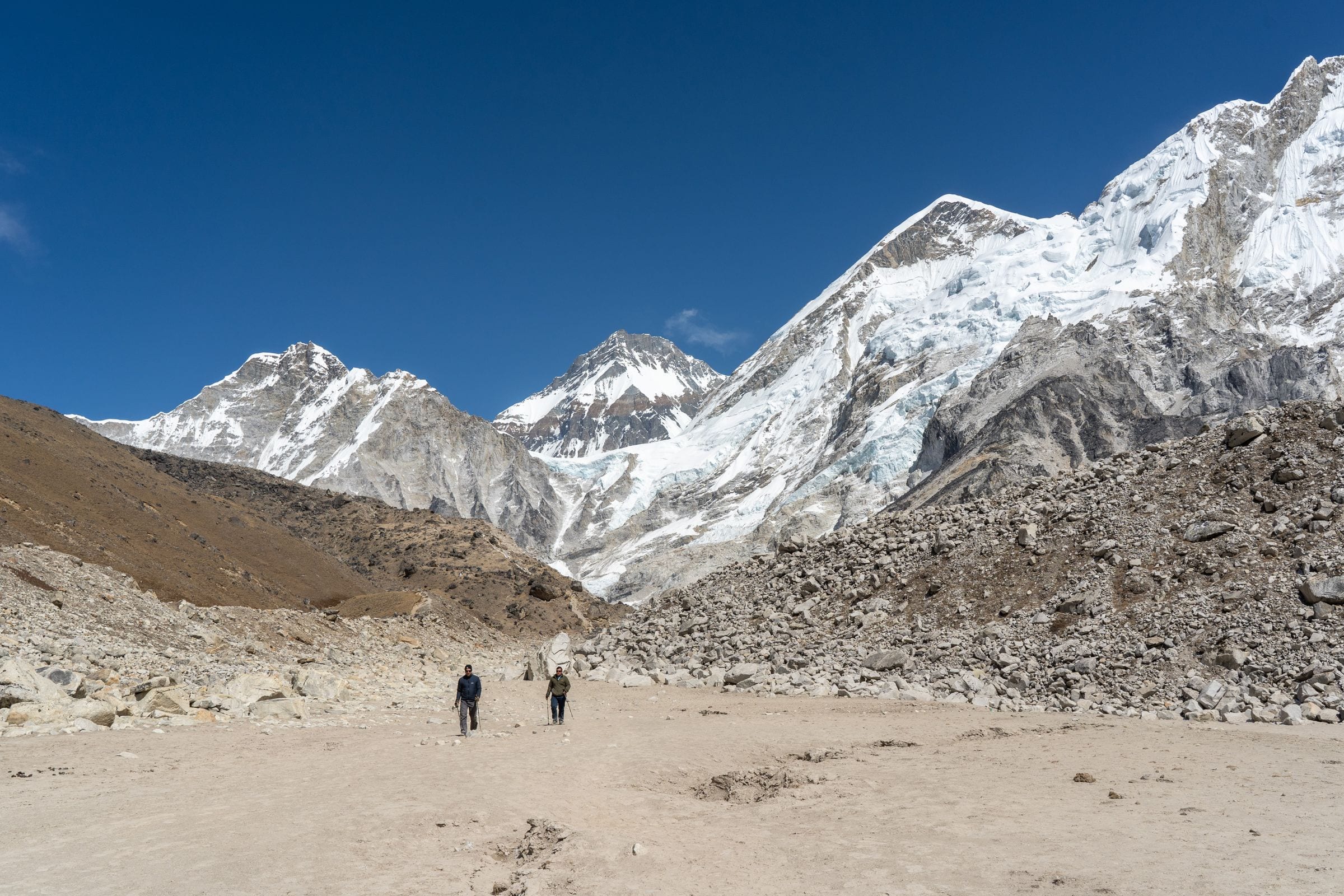 Walking time4–5 hrsSleeping altitude4,410 mDistance5 kmMealsBBreakfast includedLLunch includedDDinner includedTeahouseTeahouse, twin share
Day 8Dingboche to Lobuche4,940 m5–6 hrs
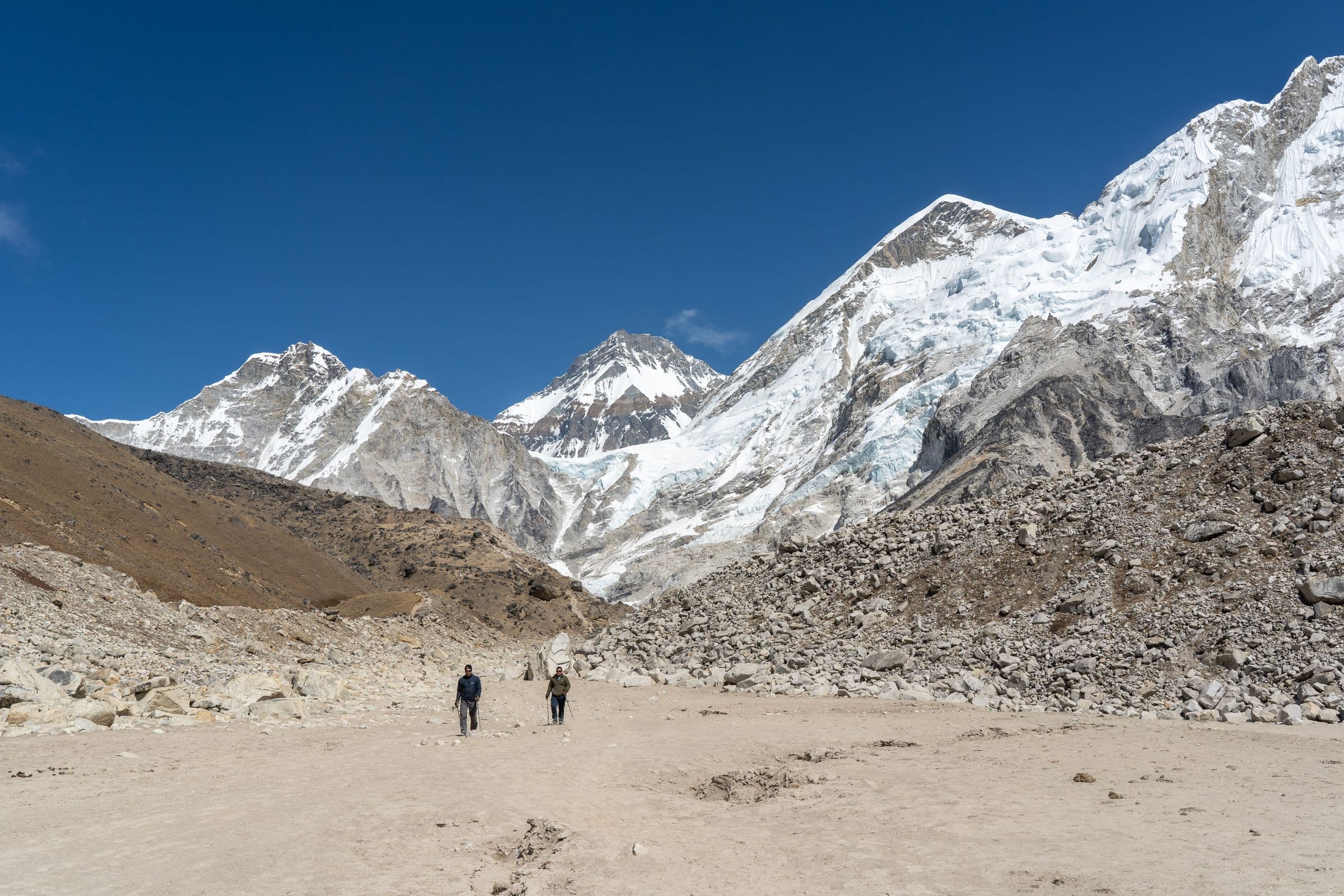
A gentle traverse to Thukla, then the hardest hour of the trek so far: a 200 m grind up the terminal moraine of the Khumbu Glacier. At the top is Thukla Pass, a windswept shelf of memorial cairns for climbers who did not come back, Scott Fischer's among them. It is a quiet place and most groups stop talking. From there the valley flattens and the walk into Lobuche runs alongside the glacier itself.
- Memorial cairns at Thukla Pass, 4,830 m
- Walking beside the Khumbu Glacier from here
- Short day by design: you are sleeping close to 5,000 m
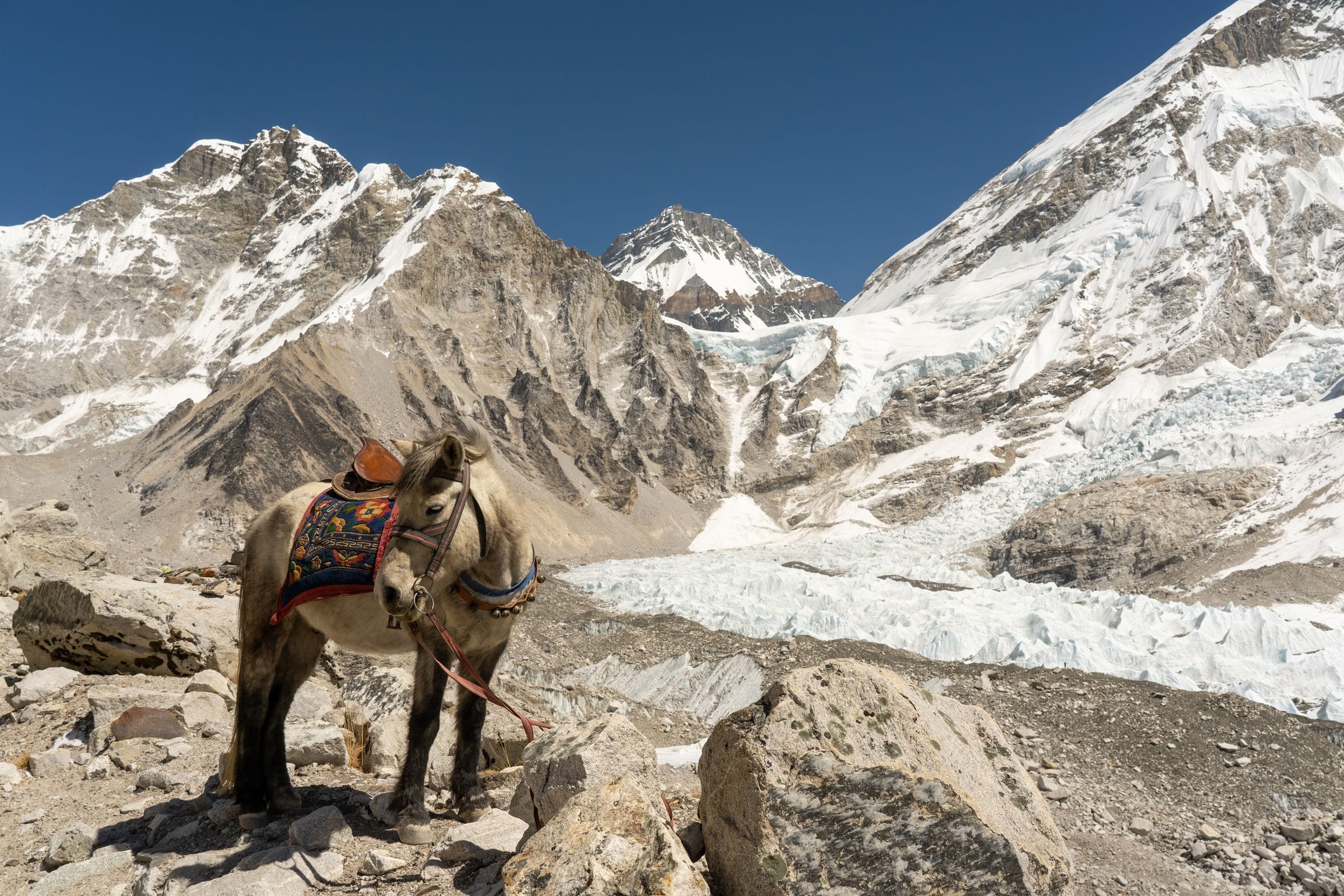 Walking time5–6 hrsSleeping altitude4,940 mDistance8.5 kmMealsBBreakfast includedLLunch includedDDinner includedTeahouseTeahouse, twin share
Day 9Lobuche to Everest Base Camp, sleep at Gorak Shep5,164 m· high 5,364 m8–9 hrs
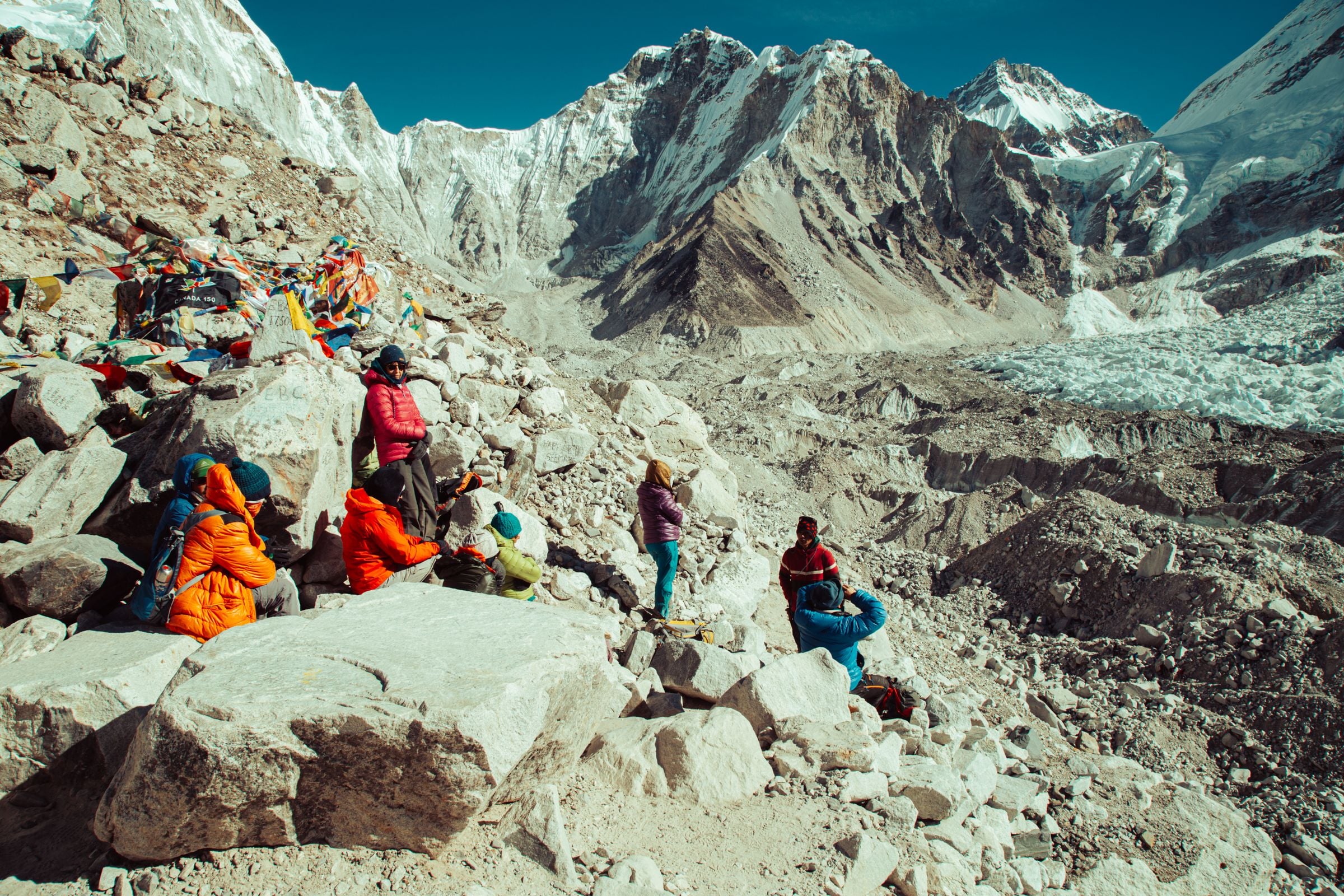
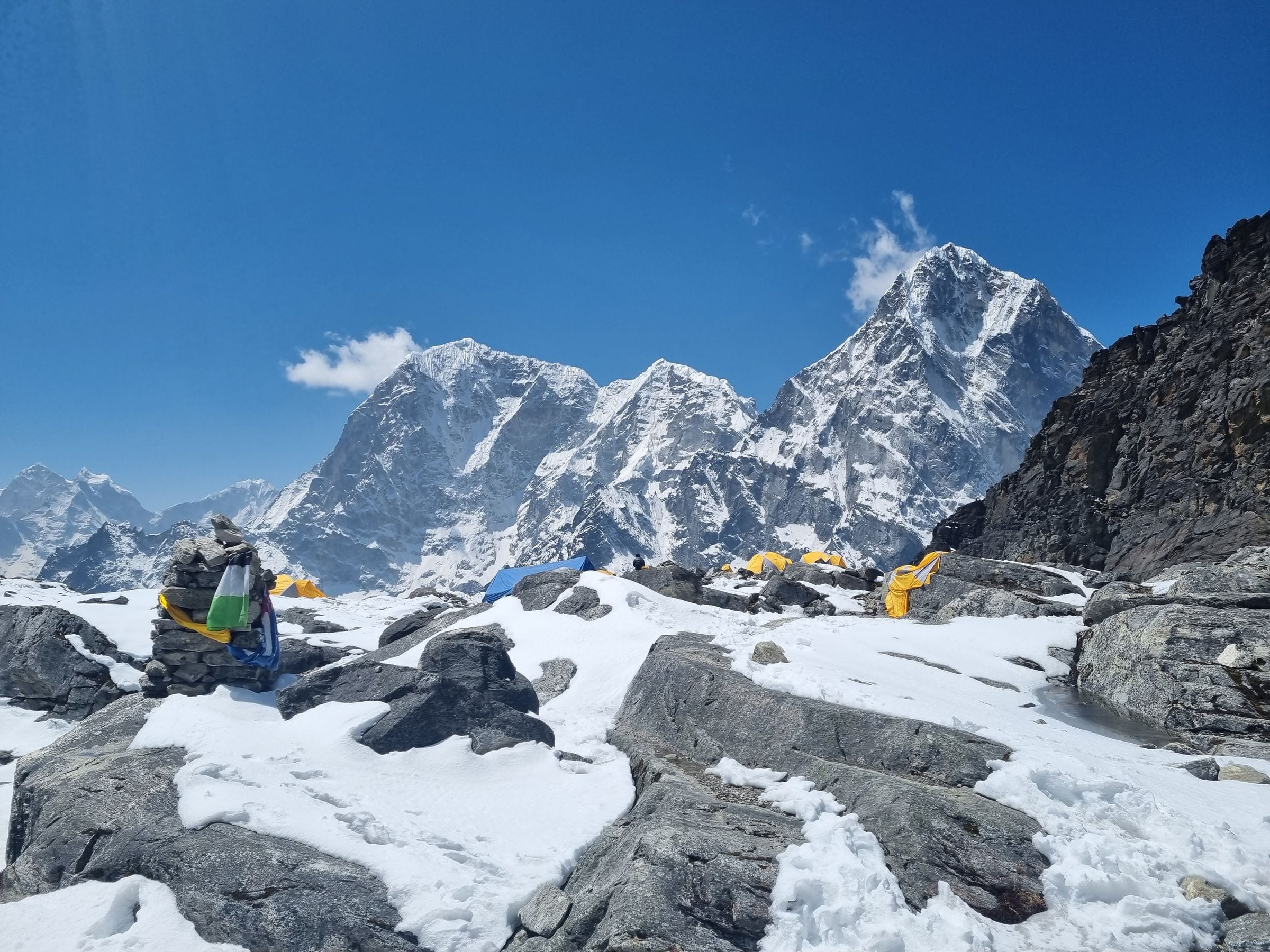
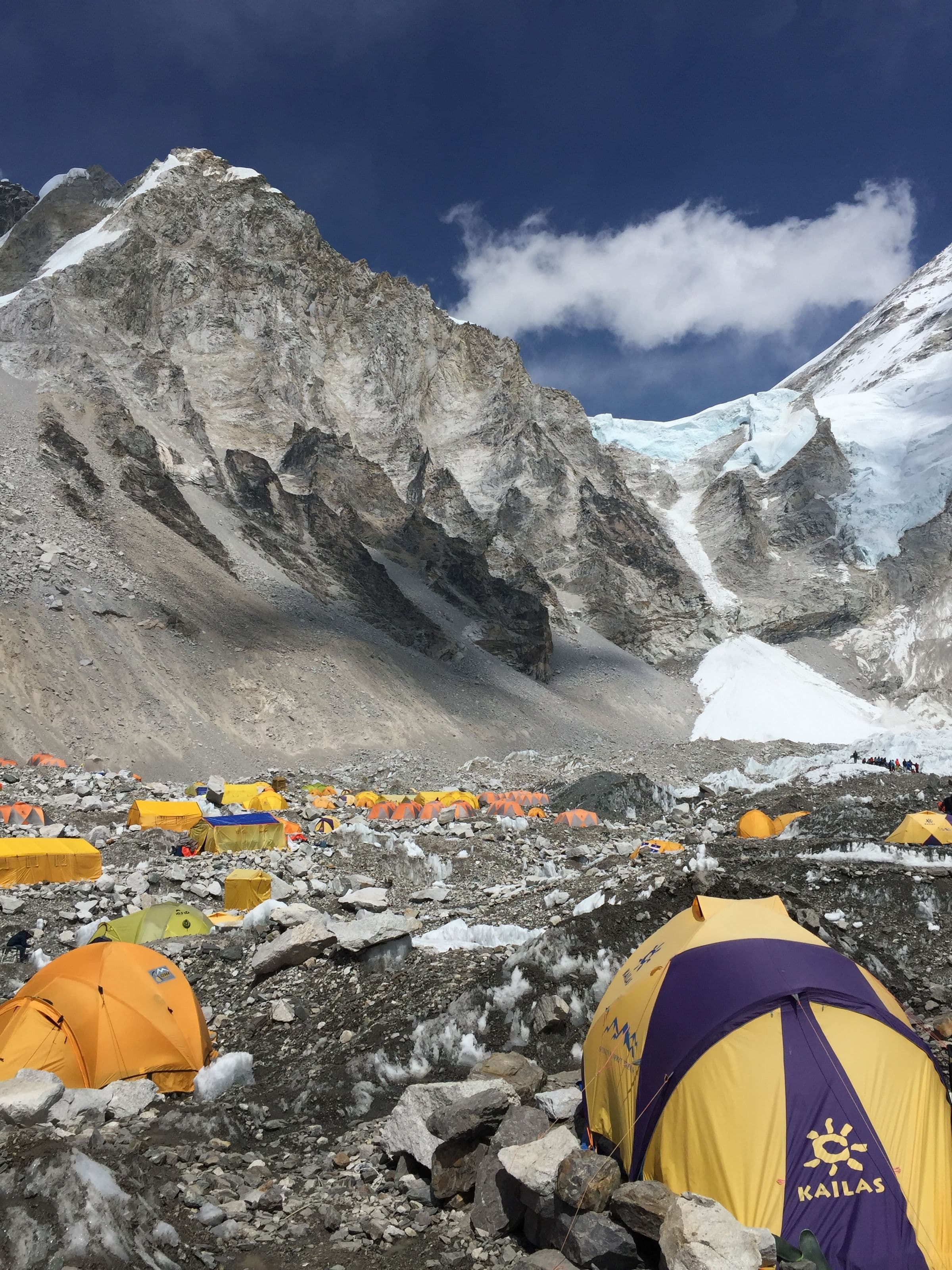
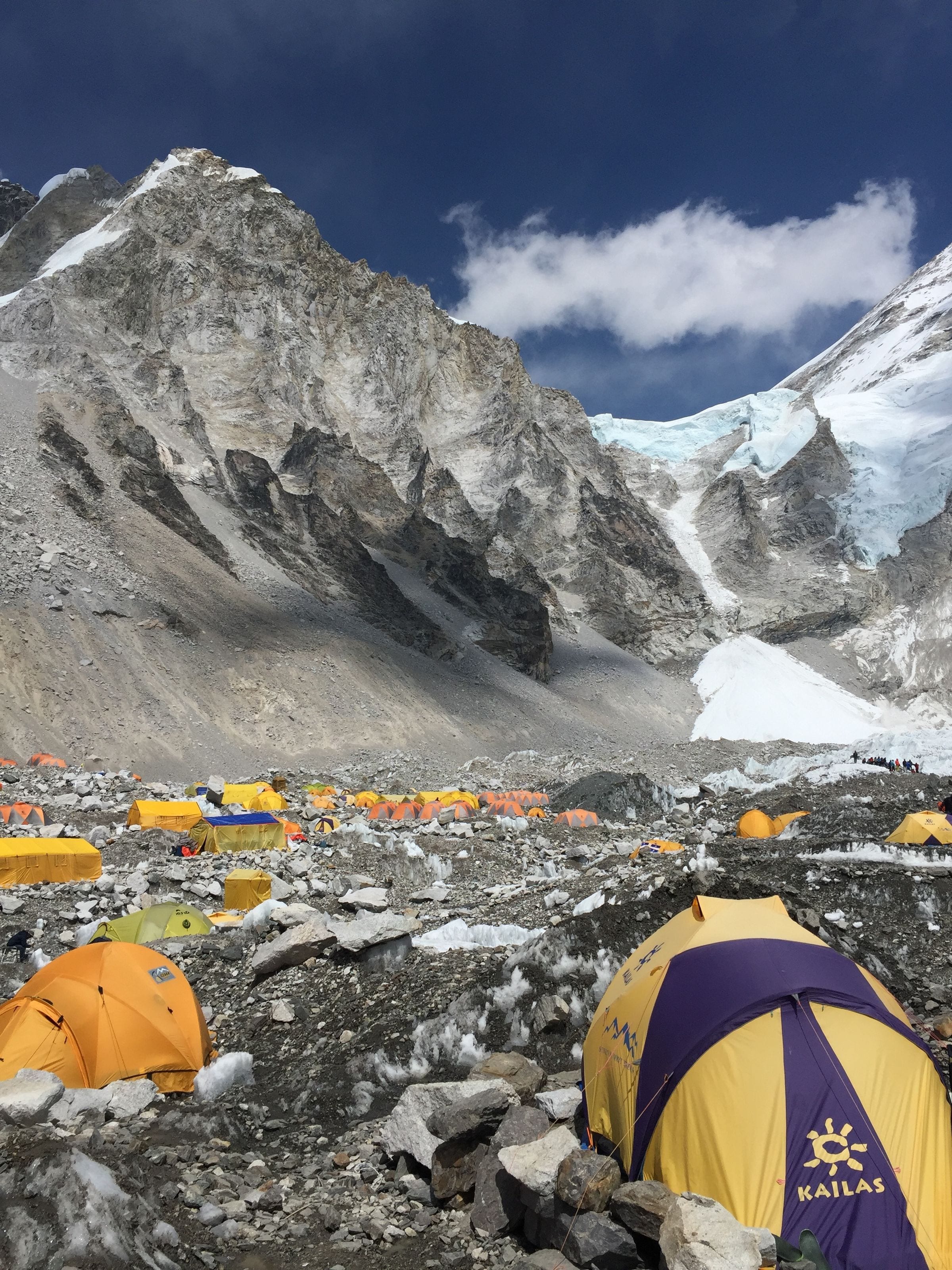
The big one. Three hours over rock and glacier rubble to Gorak Shep, a lunch you will not much want, then the two-hour picking route along the lateral moraine to Base Camp at 5,364 m. In spring it is a small yellow city under the Khumbu Icefall; outside the climbing season it is a boulder field, a painted rock and the loudest silence you will ever stand in. Everest itself is hidden behind Nuptse from here. That view is tomorrow's. We walk back to Gorak Shep for an early dinner.
- Everest Base Camp, 5,364 m, the reason you came
- Roughly six hours of walking above 5,000 m
- Highest and most basic lodge night of the trek
 Walking time8–9 hrsSleeping altitude5,164 mDistance13 kmMealsBBreakfast includedLLunch includedDDinner includedTeahouseTeahouse, twin share, basic
Day 10Kala Patthar at sunrise, descend to Pheriche4,240 m· high 5,545 m7–8 hrs
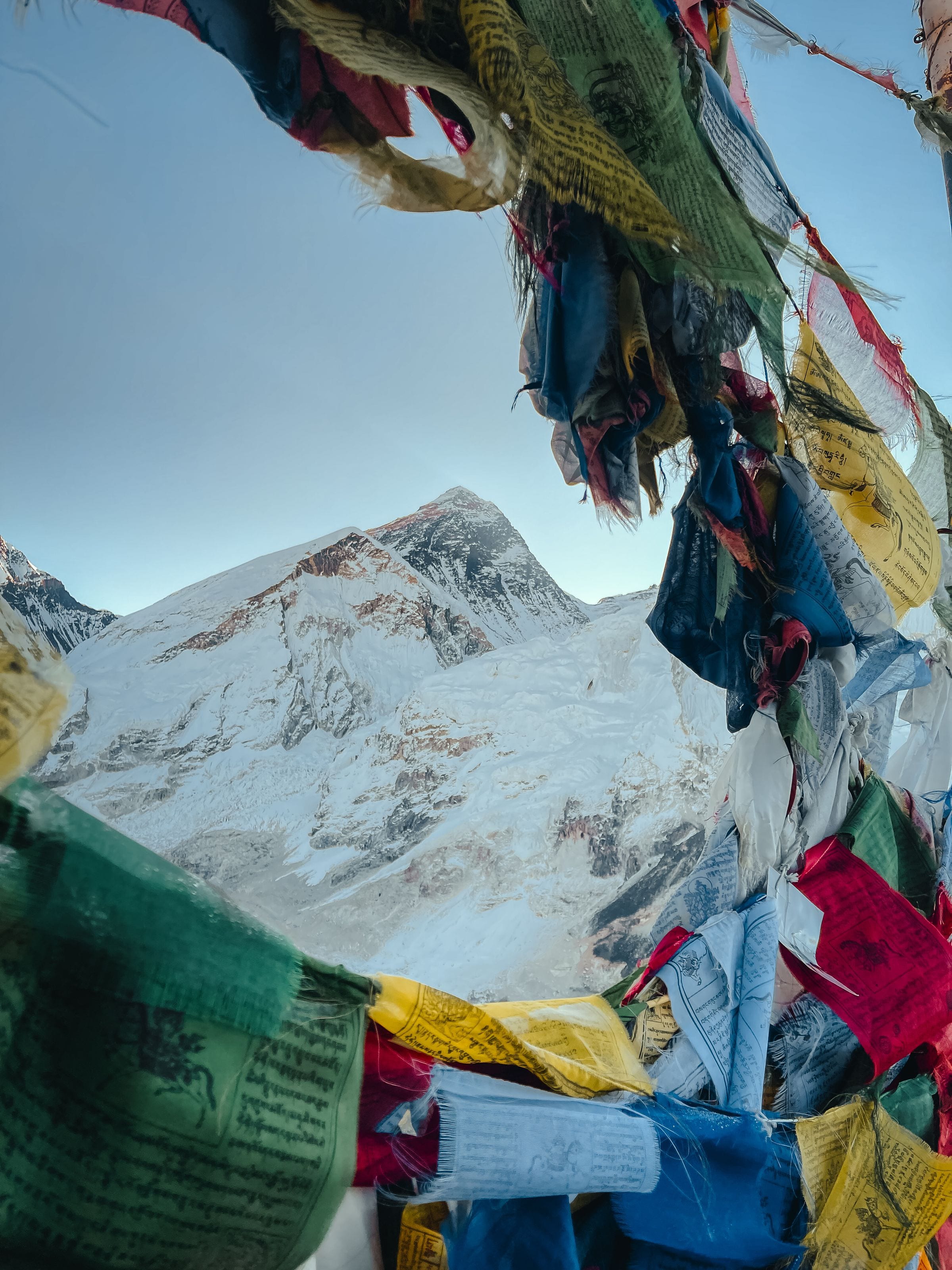
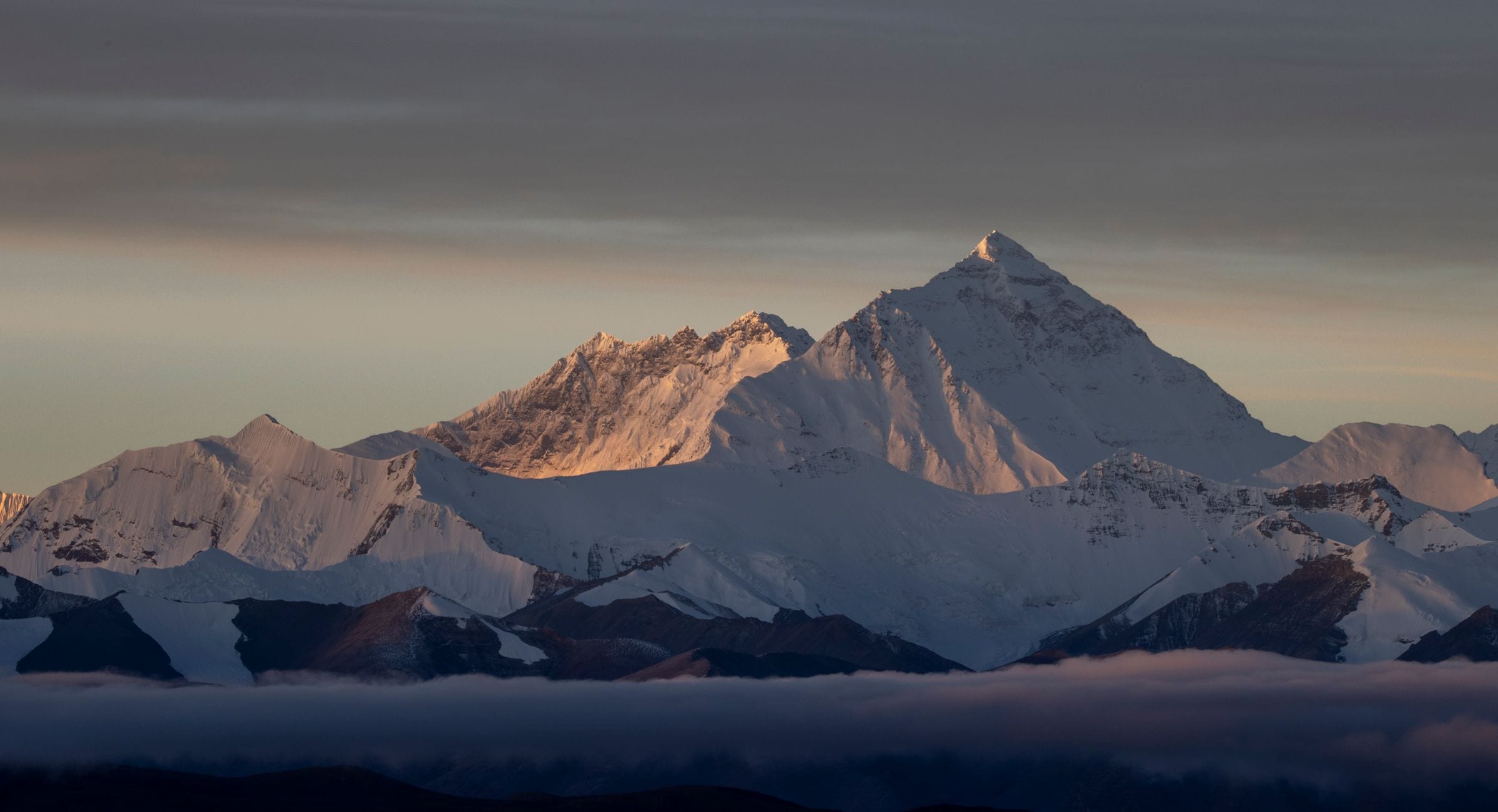
Head torches on at 4.30 am for the 380 m climb up Kala Patthar. It is cold, it is steep and it is the finest viewpoint in the Khumbu: at 5,545 m the whole south-west face of Everest stands clear above the Icefall, with Pumori at your back and Nuptse close enough to feel. We watch the light come up, take the photograph everyone takes, then drop 1,300 m through Lobuche and Thukla to Pheriche. Thicker air, warmer beds, and the best night's sleep of the fortnight.
- Kala Patthar, 5,545 m, the trek's high point
- 1,300 m of descent: appetite and sleep return
- Himalayan Rescue Association clinic and its altitude talk
 Walking time7–8 hrsSleeping altitude4,240 mDistance16 kmMealsBBreakfast includedLLunch includedDDinner includedTeahouseTeahouse, twin share
Day 11Pheriche to Namche Bazaar3,440 m6–7 hrs
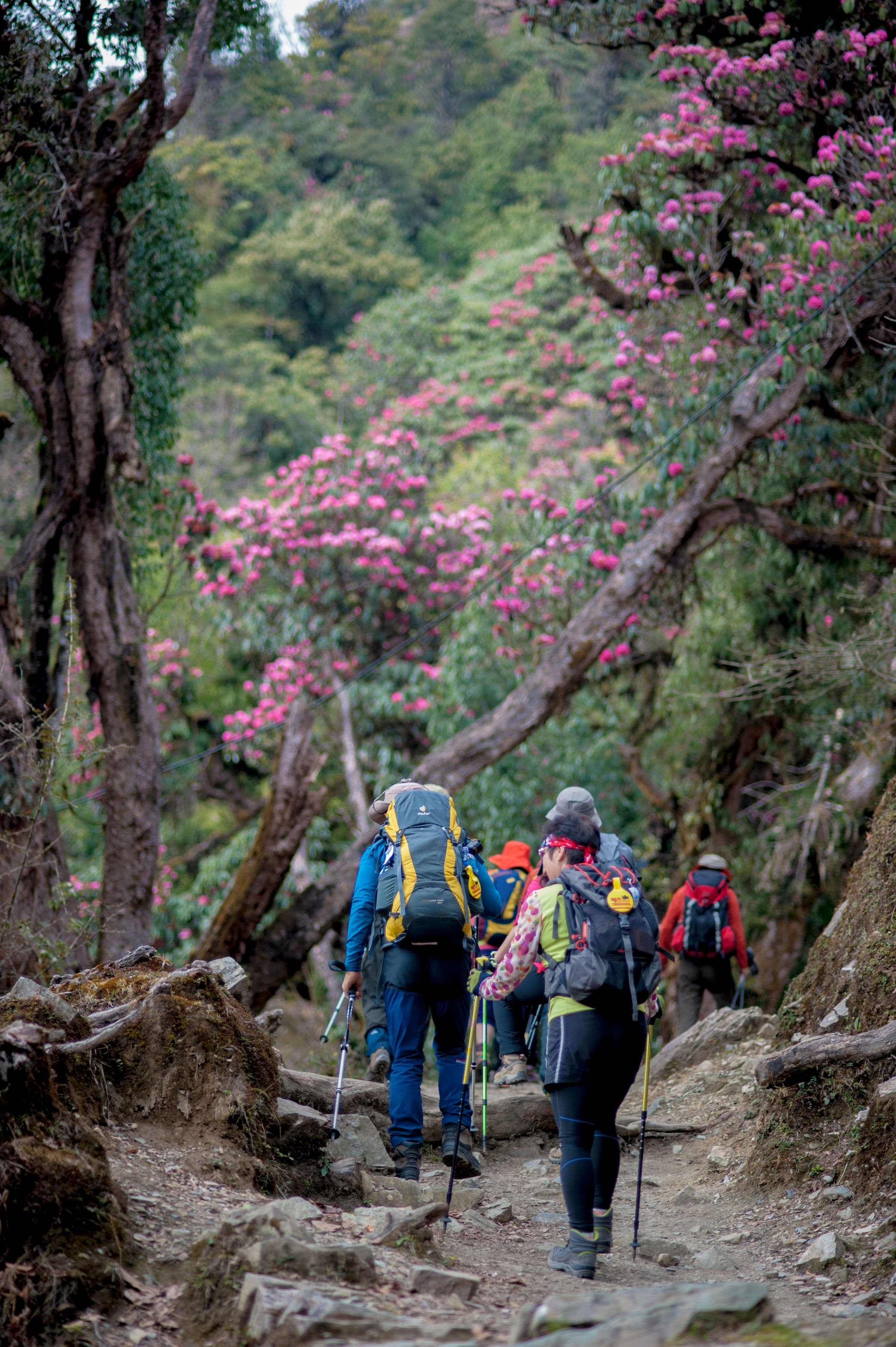
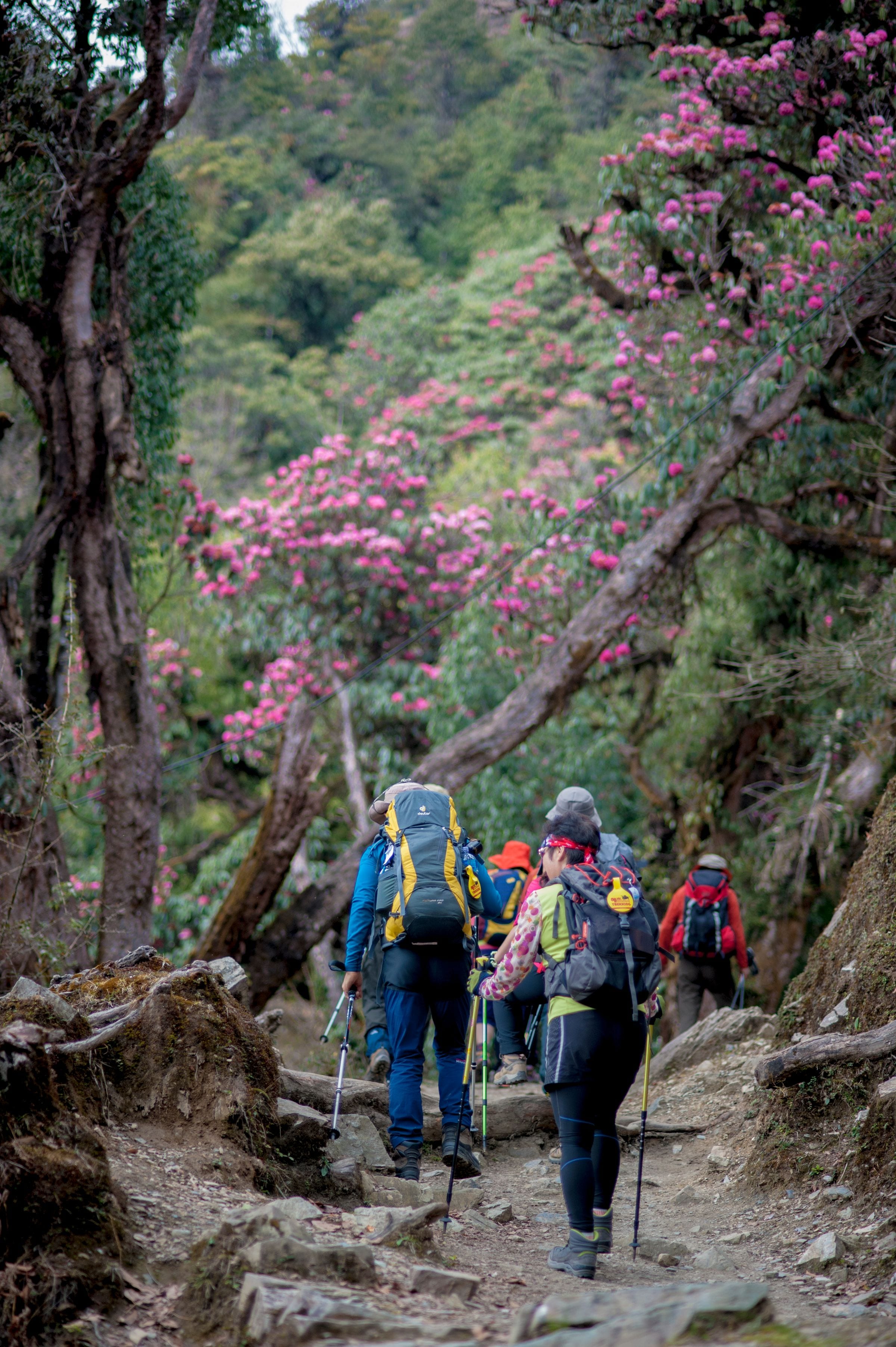
A long, generous downhill through country you last saw on the way up and barely recognise now that you are not gasping in it. Rhododendron closes back over the trail below Tengboche, scarlet the whole way in April, and the smell of woodsmoke and pine comes back. Namche at the end of it feels like a capital city: hot shower, bakery, a beer if you want one, and a room with a door that shuts.
- Back below the treeline and into the forest
- Hot showers, bakeries and the first proper rest
- Optional Saturday market if the day falls right
 Walking time6–7 hrsSleeping altitude3,440 mDistance15 kmMealsBBreakfast includedLLunch includedDDinner includedTeahouseTeahouse, en-suite twin room
Day 12Namche Bazaar to Lukla2,840 m6–7 hrs
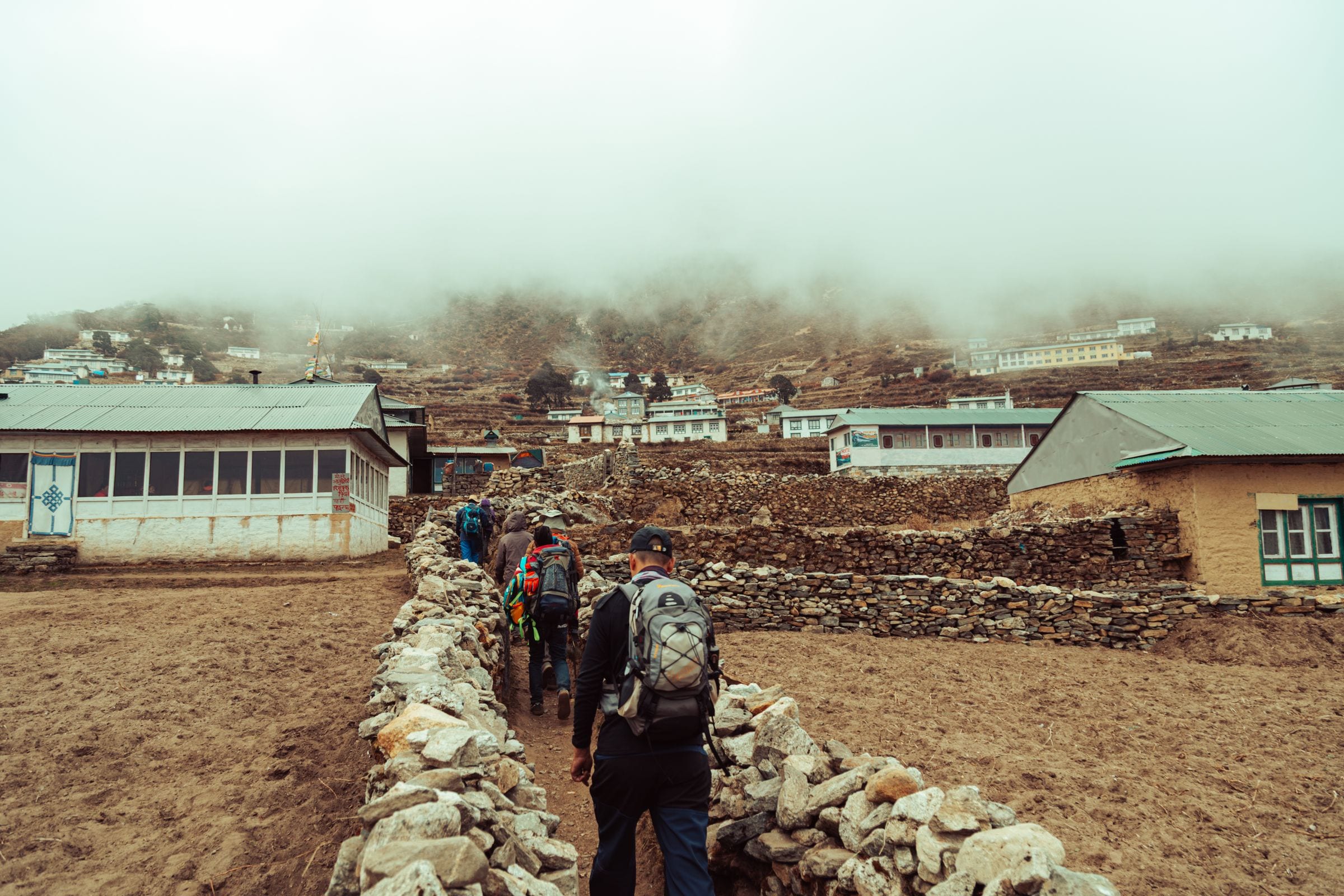
The last full day on the trail: down the Namche hill, back across the bridges, and a long undulating valley walk through Monjo, Phakding and Ghat that stings a little in the final hour. Lukla arrives with the runway lights on and the whole thing behind you. Tonight is the crew's night: we settle up, hand out the tips you have agreed as a group, and the guides and porters usually dance. So, eventually, does everyone else.
- Longest distance of the trek, all of it downhill or flat
- Farewell evening with the guides and porters
- Duffels packed for the morning flight
 Walking time6–7 hrsSleeping altitude2,840 mDistance18.5 kmMealsBBreakfast includedLLunch includedDDinner includedTeahouseTeahouse, en-suite twin room
Day 13Fly Lukla to Kathmandu1,400 m35 min flight
Morning flights leave Lukla before the valley wind gets up, so we are usually back in Kathmandu by breakfast. The afternoon is yours for a massage, the Thamel bookshops or the last of your shopping, and we hold your room from arrival so you can shower properly for the first time in a fortnight. Farewell dinner with the office team, certificates, and the photographs your guide has been taking all trip.
- Contingency day built in before your flight home
- Late-checkout room held from arrival
- Farewell dinner with live music and trek certificates
 Walking time35 min flightSleeping altitude1,400 mDistanceTransfer to hotelMealsBBreakfast includedLLunch not includedDDinner includedHotelHotel Thamel Park, twin share
Day 14Departure1,400 mNo walking
Breakfast, then a transfer to the airport three hours before your flight. If you are staying on we are happy to book the extra nights at our rate, arrange a Pokhara add-on or a Chitwan safari, or simply leave your bags at the office while you spend a last day in the valley.
- Departure transfer at any hour
- Extra nights and add-ons arranged at cost
- Luggage storage at our Thamel office
 Walking timeNo walkingSleeping altitude1,400 mDistanceAirport transferMealsBBreakfast includedLLunch not includedDDinner not includedHotelNo overnight
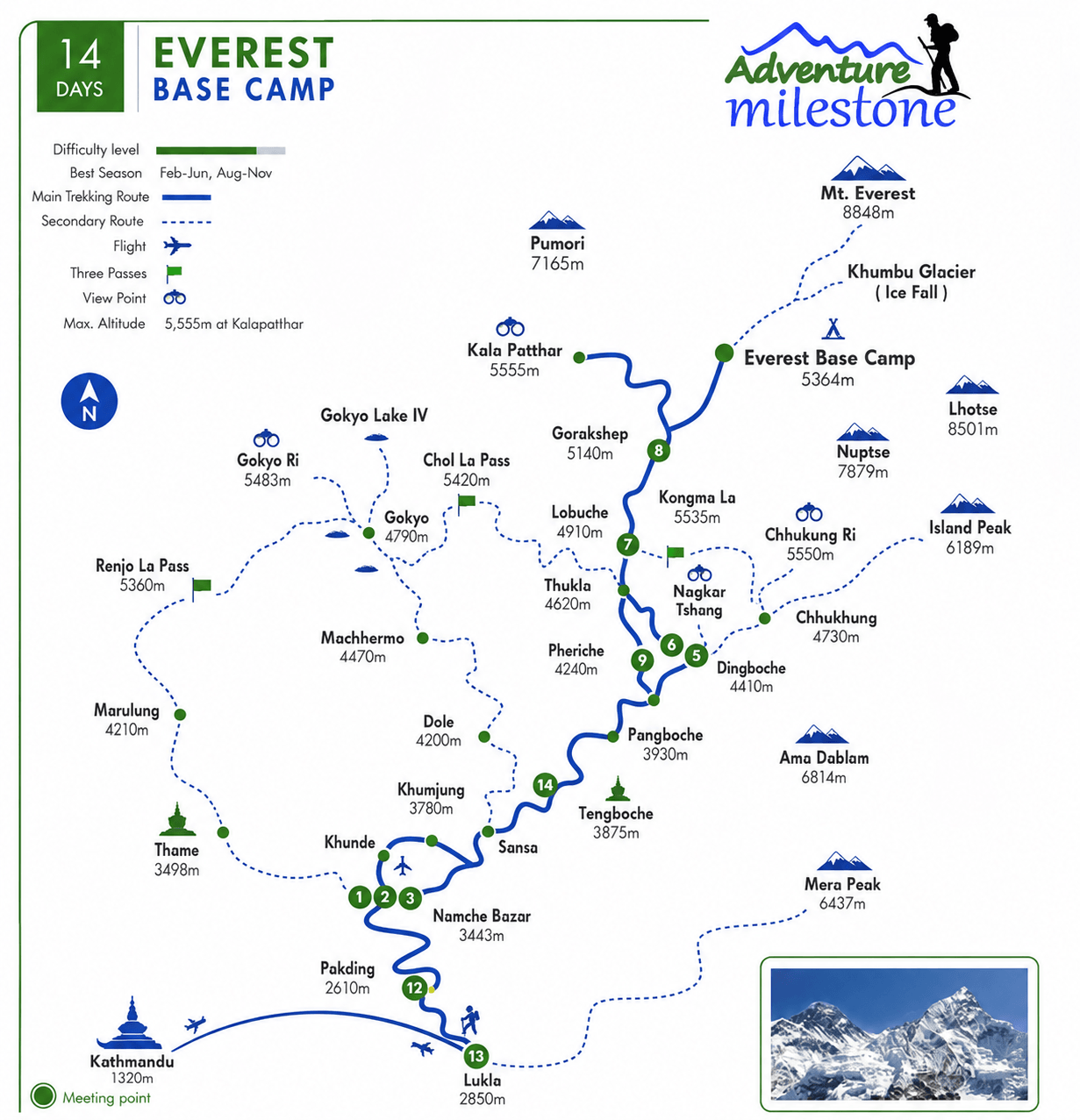
The route
The whole trail on one sheet.
Dates and prices
Departures run from two travellers. Prices are per person, twin share.
DepartureAvailabilityPriceBooking
06 – 19 Oct 2026
Tue → Mon · 14 days
Available$1,490
per person
20 Oct – 02 Nov 2026
Tue → Mon · 14 days
Not available$1,490
per person
03 – 16 Nov 2026
Tue → Mon · 14 days
Available$1,490
per person
17 – 30 Nov 2026
Tue → Mon · 14 days
Available$1,490
per person
09 – 22 Mar 2027
Tue → Mon · 14 days
Available$1,490
per person
30 Mar – 12 Apr 2027
Tue → Mon · 14 days
Available$1,490
per person
13 – 26 Apr 2027
Tue → Mon · 14 days
Available5 spaces left$1,490
per person
04 – 17 May 2027
Tue → Mon · 14 days
Available$1,490
per person
None of these dates work?
We run this trek privately on any date in the season, for any party from one person upwards, and we will move the acclimatisation days around your flights rather than the other way about.
Pick a start date and we will price these 14 days
What's included
Included
14 itemsIn the price on this page
- Private airport transfers on arrival and departure, at any hour
- 3 nights' twin-share hotel in Thamel, Kathmandu, with breakfast
- 10 nights' teahouse accommodation on the trail, twin share, booked ahead
- 13 breakfasts, 11 lunches and 13 dinners, ordered from the full menu
- Kathmandu–Lukla–Kathmandu flights, including the peak-season Ramechhap transfer
- Sagarmatha National Park entry and Khumbu Rural Municipality permits
- Government-licensed, English-speaking guide born and raised in the Khumbu
- One porter for every two trekkers, carrying within the 20 kg IPPG limit
- All crew wages, insurance, food, lodging and transport
- Duffel bag, down jacket and four-season sleeping bag on loan
- Twice-daily pulse oximeter monitoring and a comprehensive first-aid kit
- Sagarmatha Next, Sherpa Culture Museum and Tengboche monastery entry
- Farewell dinner with cultural performance, and your trek certificate
- All government taxes, VAT and our service charge
Not included
10 itemsBudget for these separately
- International flights to and from Kathmandu
- Nepal visa fee: USD 30 for 15 days, issued on arrival
- Travel insurance covering helicopter evacuation above 5,500 m, which is mandatory
- Lunches and dinners in Kathmandu, apart from the welcome and farewell dinners
- Drinks, bottled water, hot showers, Wi-Fi and device charging in teahouses
- Personal trekking clothing and equipment beyond the three items we lend
- Extra nights in Kathmandu caused by an early return or a flight delay
- Emergency evacuation, medical treatment and rescue costs
- Tips for your guide and porters: customary, and entirely your call
- Anything not listed under what is included
What to bring
The packing list we send every traveller, written against the weight limit.
One weight limit matters, and the aircraft sets it
15 kgThe Lukla flight
10 kg checked and 5 kg in hand, and it is weighed
In practice the aircraft is the constraint, not the porter: your duffel may weigh up to 20 kg, shared between two trekkers, but the flight is weighed at 15 kg and that is the number to pack to. Anything you are not taking up the hill is stored free at our Kathmandu office, and we provide the duffel, the sleeping bag and the down jacket, so leave those three at home.
On your head
Sun hat with a brim, and a warm hat that covers your ears
Buff or neck gaiterTwo of them
Sunglasses, category 3 or 4Snow glare above Lobuche is serious
Headtorch and spare batteriesKala Patthar starts at four in the morning
Sunscreen SPF 50 and lip balm with sun protection
On your body
Three or four merino or synthetic base layersNo cotton
Two mid layersOne fleece and one light insulated
Down jacketWe lend thisBring your own if you sleep cold
Waterproof shell, jacket and trousersOne that packs small
Two pairs of trekking trousersOne of them lined
Underwear for four or five daysAnd wash on the way
Hands and feet
Liner gloves and insulated outer gloves or mittens
Broken-in trekking boots with ankle supportBroken in is not optional
Four pairs of trekking socksWool
Camp shoes or trainers for the evenings
GaitersIf you are going in winter or early spring
Bags
Duffel for the porterWe lend this20 kg maximum
Daypack, 30 to 35 litresWith a rain cover
Dry bags or thick linersNothing on this trail is waterproof for long
Sleeping
Sleeping bag rated to −15 °CWe lend this
Silk or cotton linerFor warmth and hygiene
EarplugsTeahouse walls are plywood
Health
Personal first aidBlister plasters, tape, painkillers, rehydration salts
Diamox, if your doctor agreesPlus anything you take routinely
Water purificationTablets, a filter, or a SteriPen
Hand sanitiser and wet wipesThere is no shower above Dingboche
Throat lozengesThe Khumbu cough is real and everybody gets it
Papers and money
Passport valid six monthsPlus two photocopies
Four passport photographsFor the permits
Travel insurance certificateShowing helicopter cover to 6,000 m
USD 300 to 500 in small notesThere is no ATM above Namche
Photographs
Shot on this route by our guides and the people who walked it.
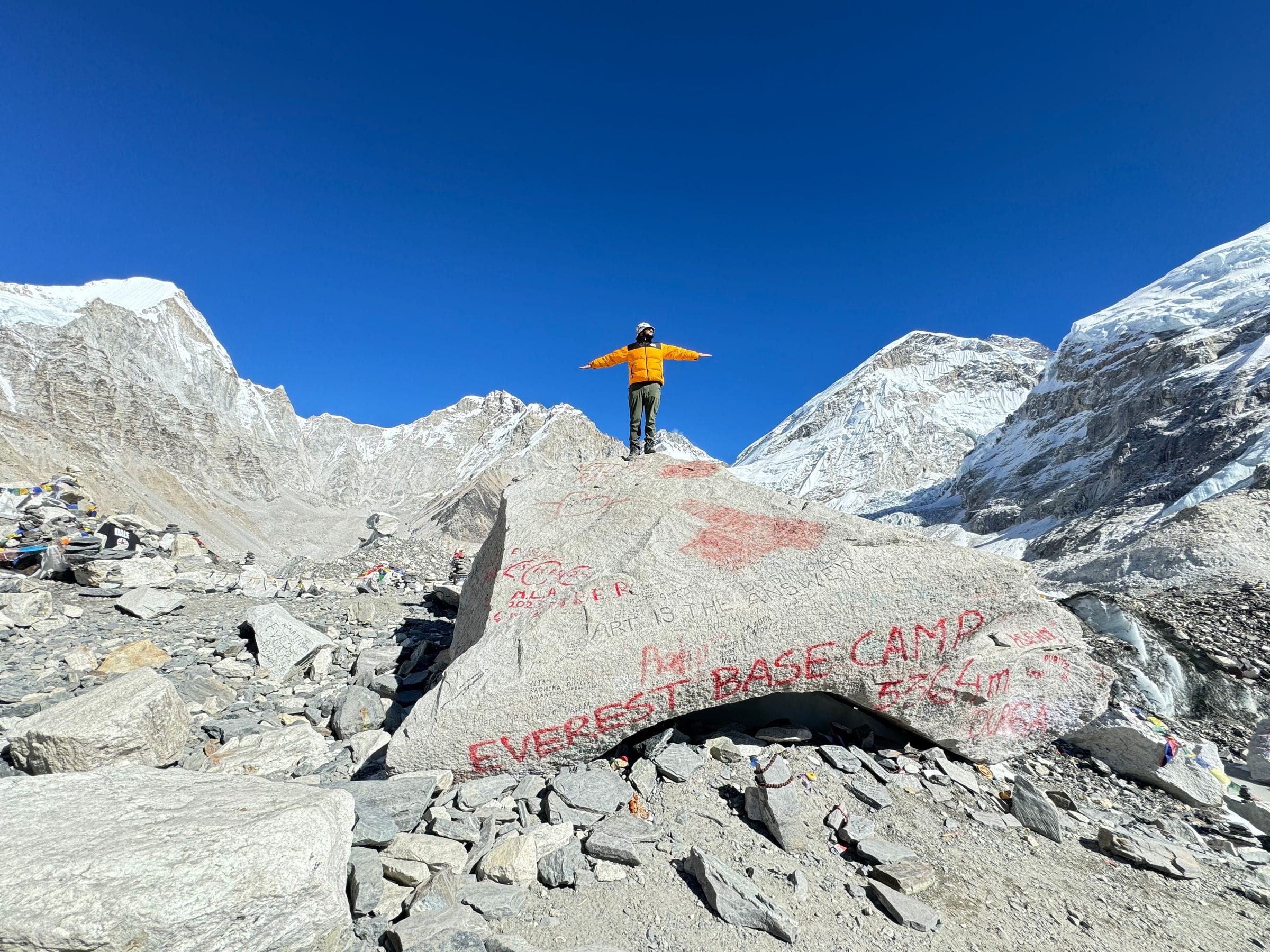 A trekker standing on the painted marker rock at Everest Base Camp
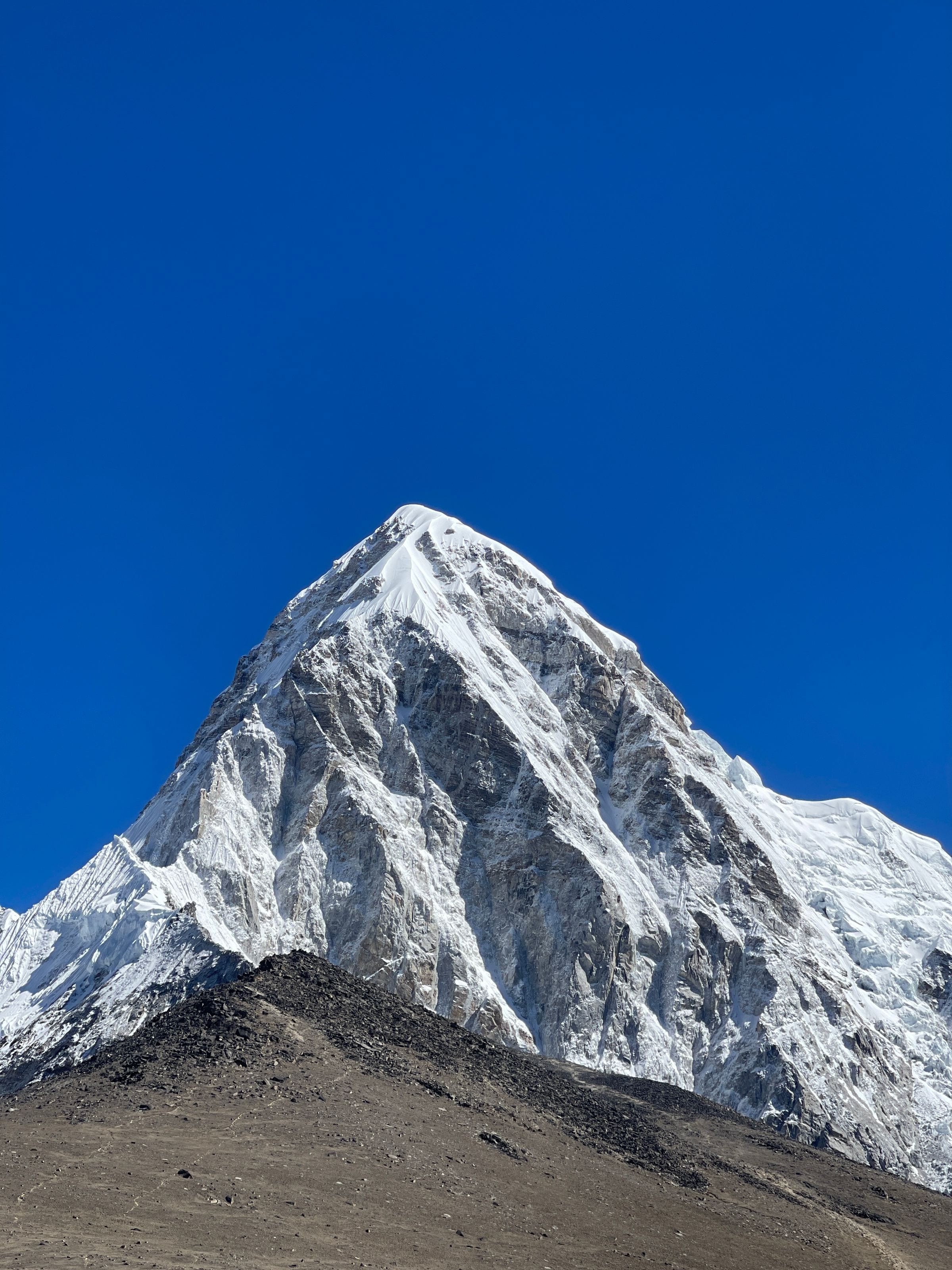 The pyramid summit of Pumori under a clear blue sky
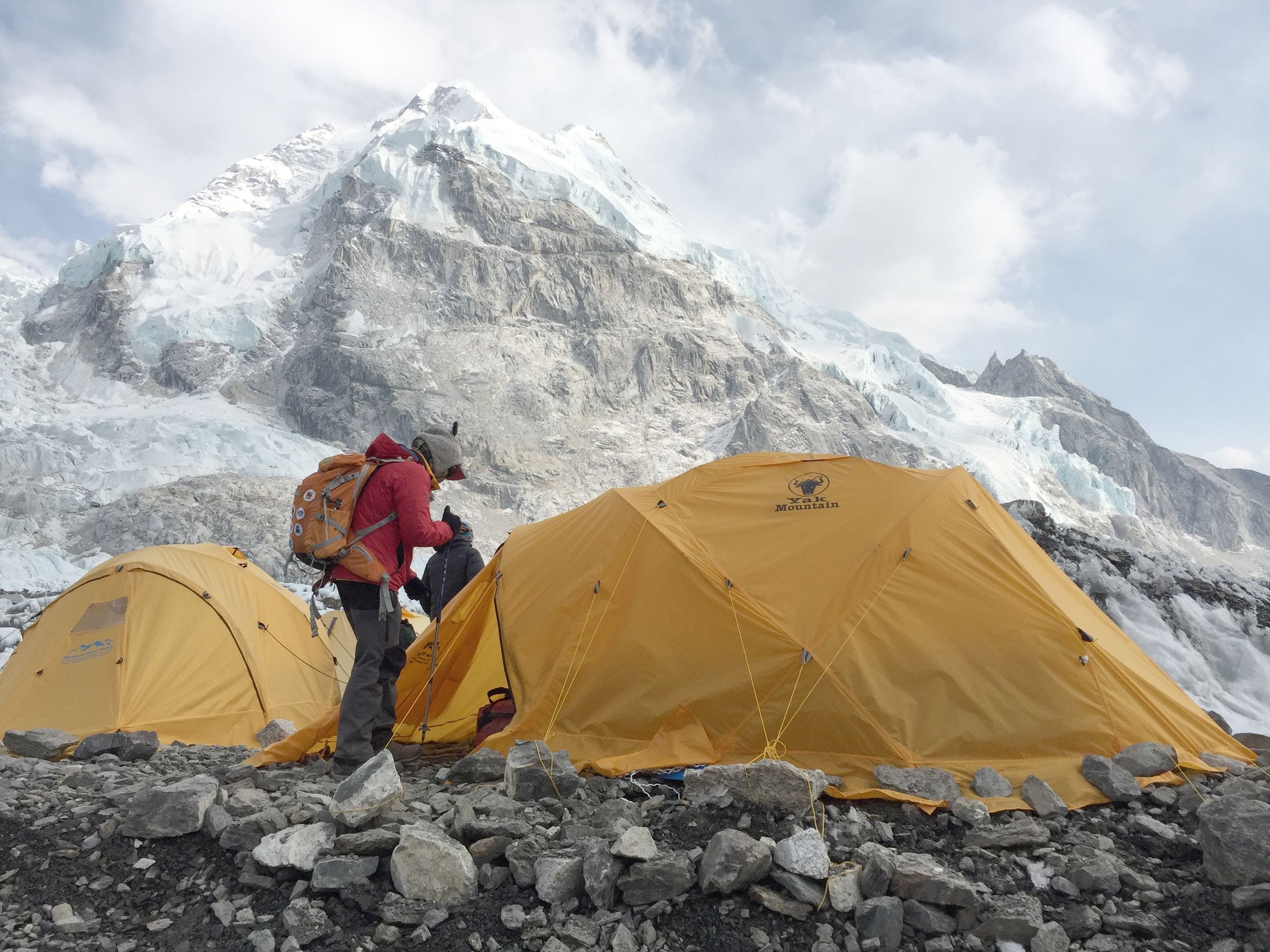 Expedition tents pitched on the glacier below the Khumbu Icefall
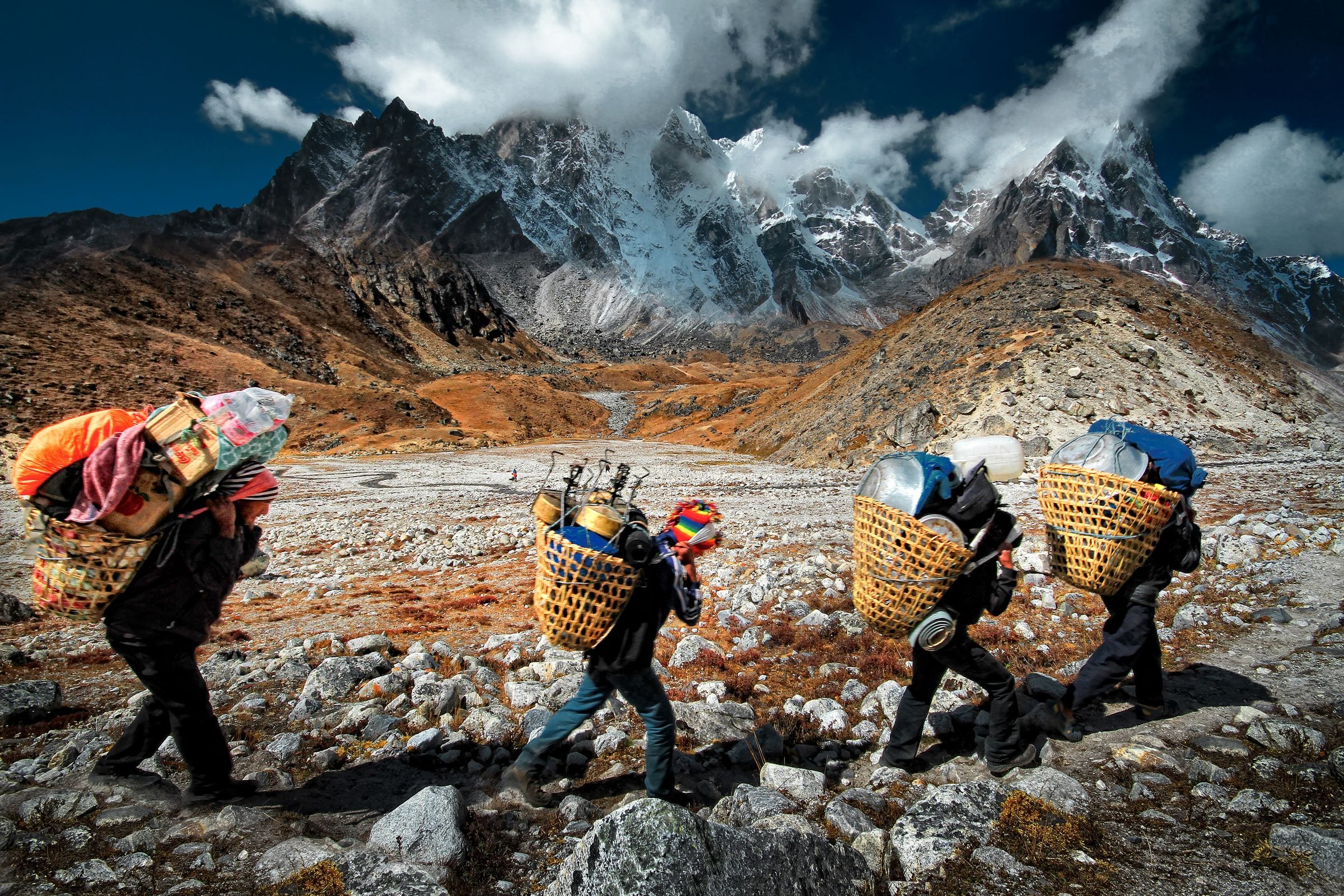 Porters carrying loads along a high Himalayan moraine trail
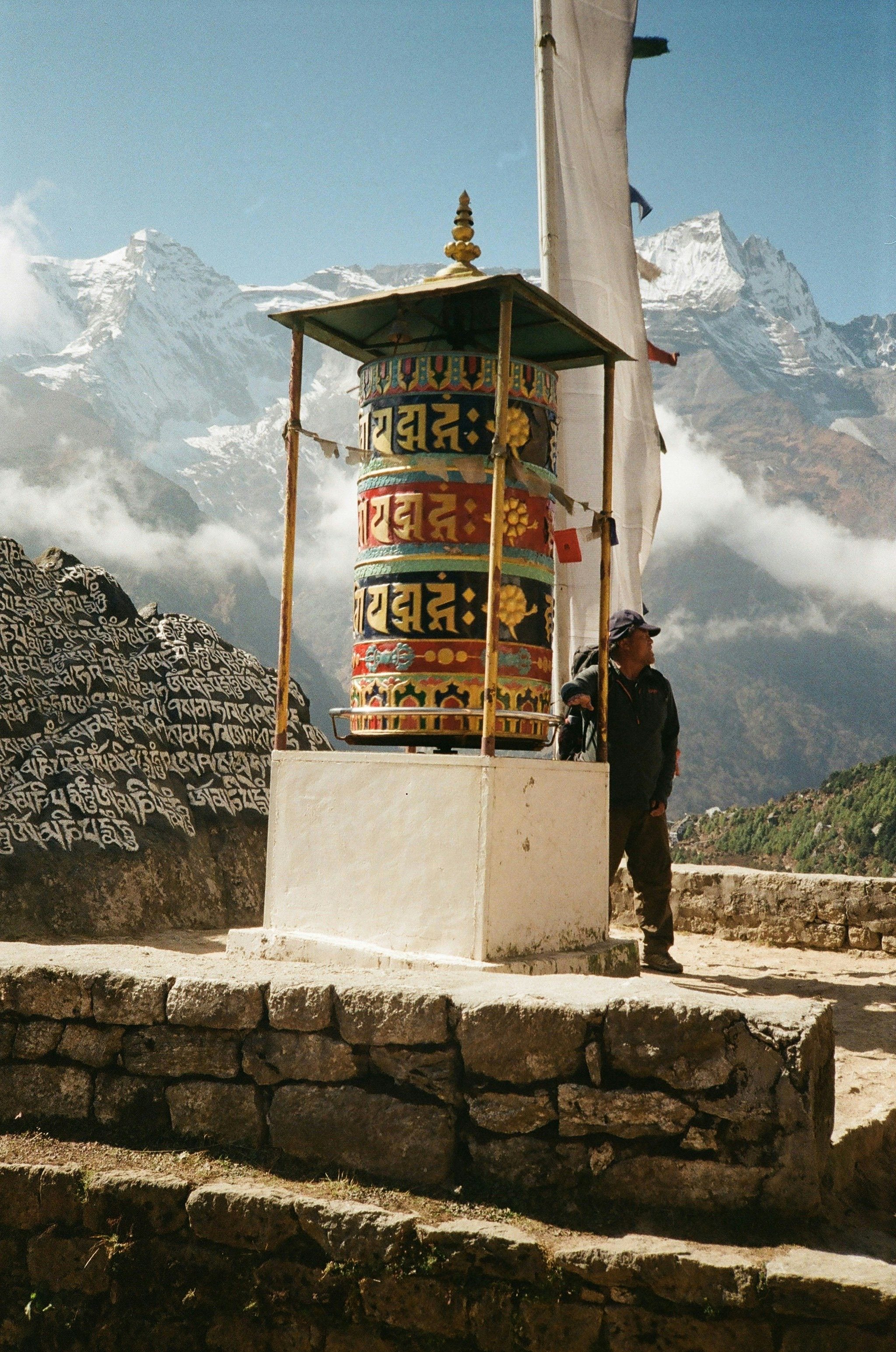 A painted chorten on the trail above Namche Bazaar
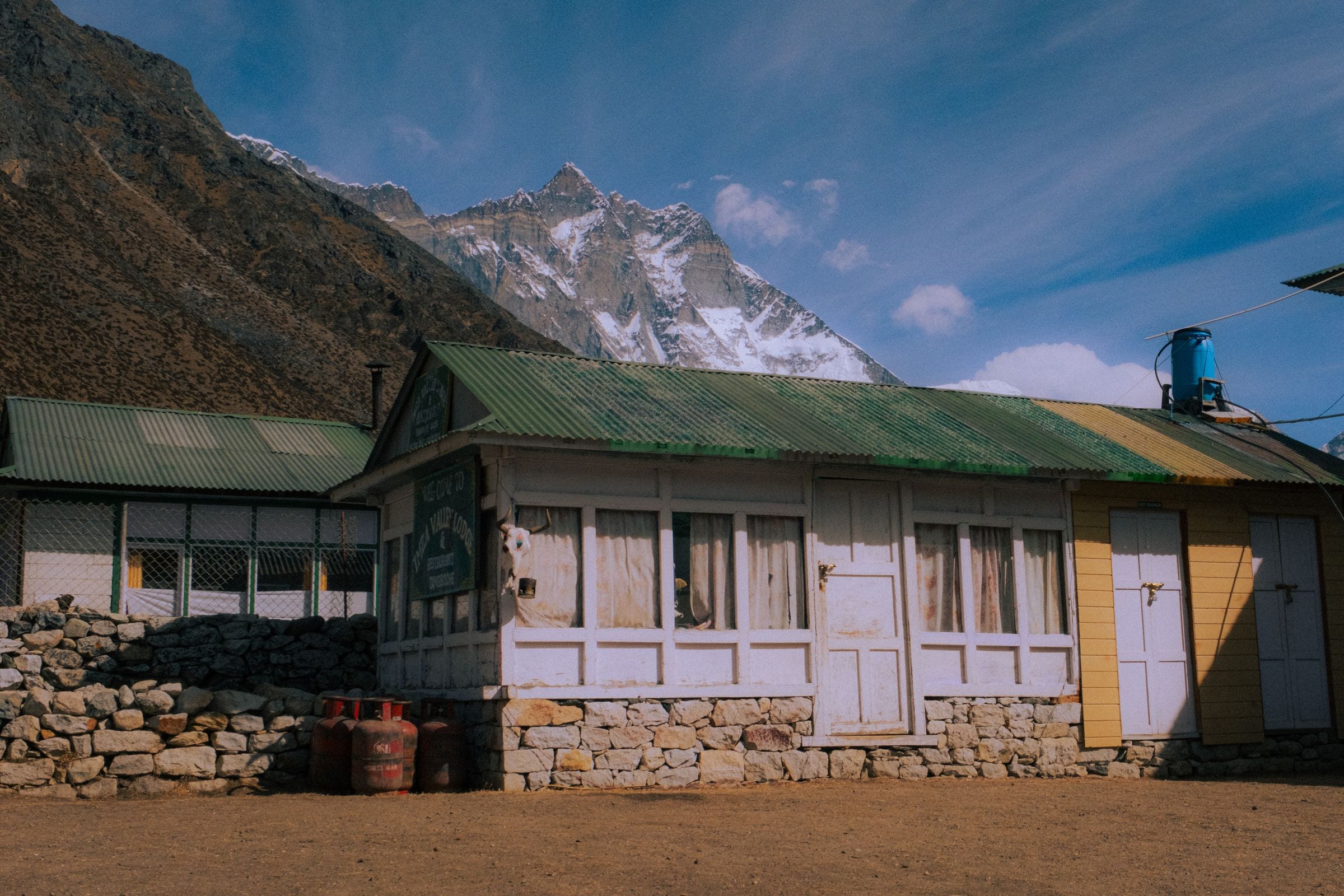 A traditional stone-and-timber teahouse lodge in the Khumbu
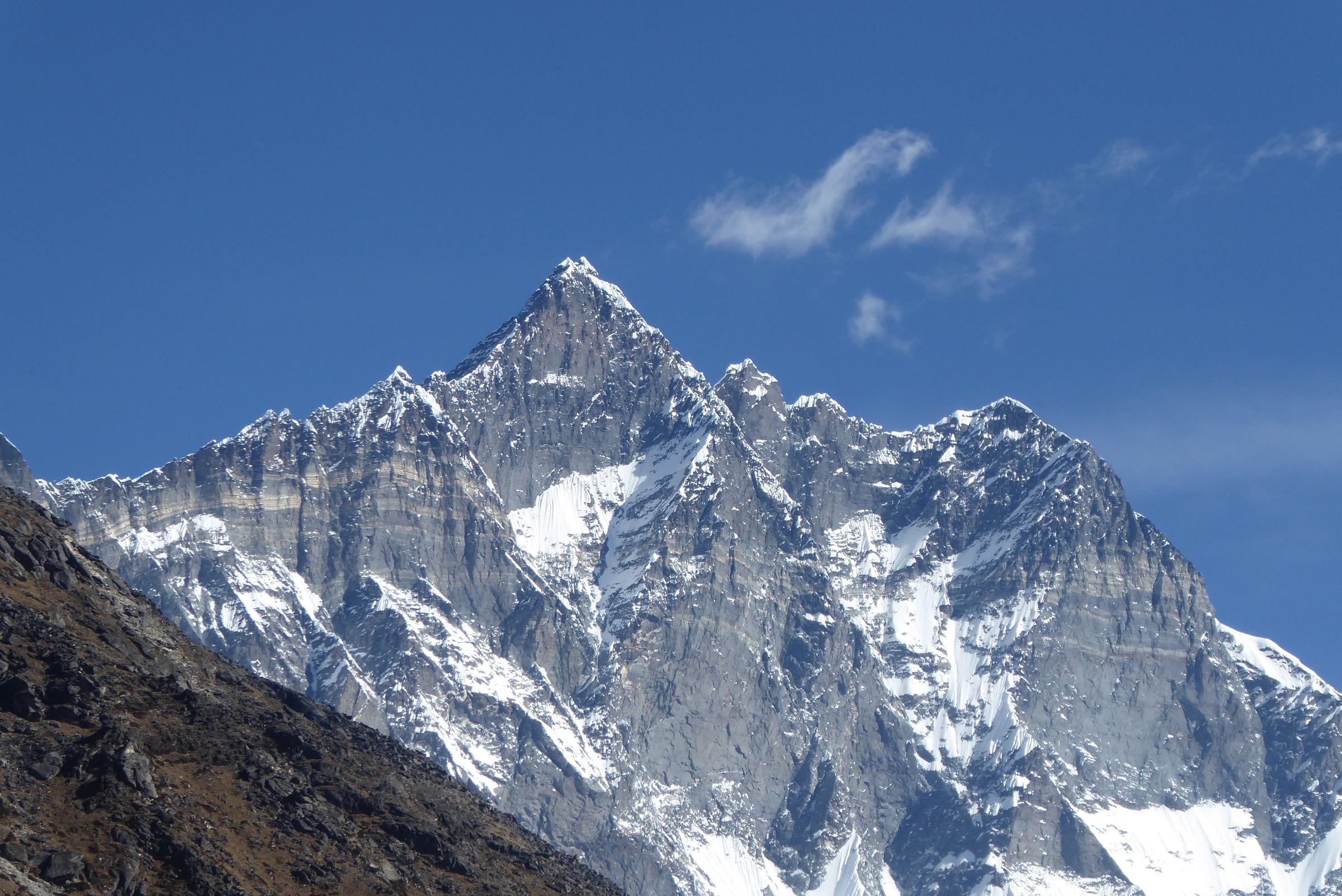 The south face of Lhotse seen from the Everest trail
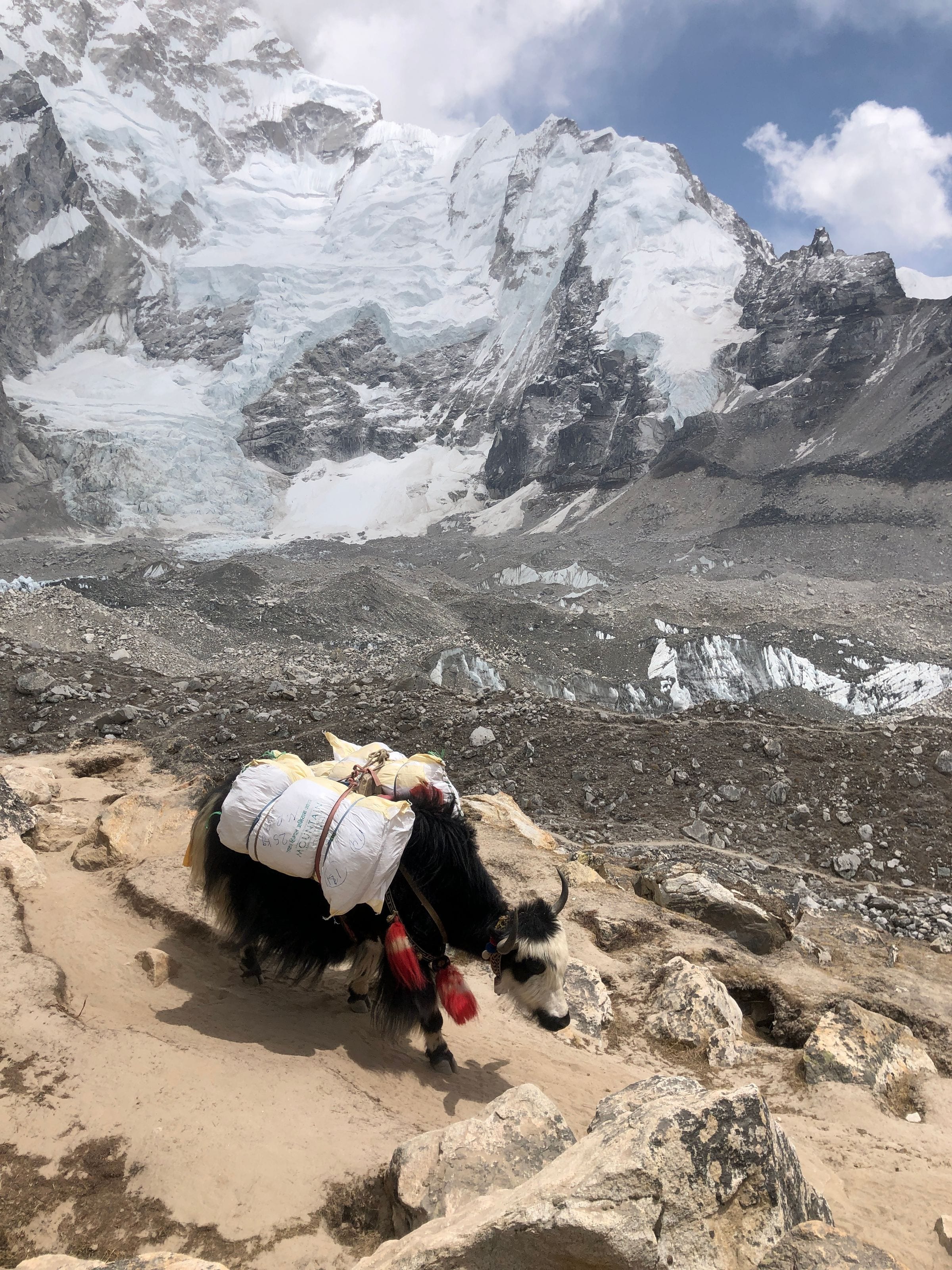 A yak on the rocky trail above the Khumbu Glacier
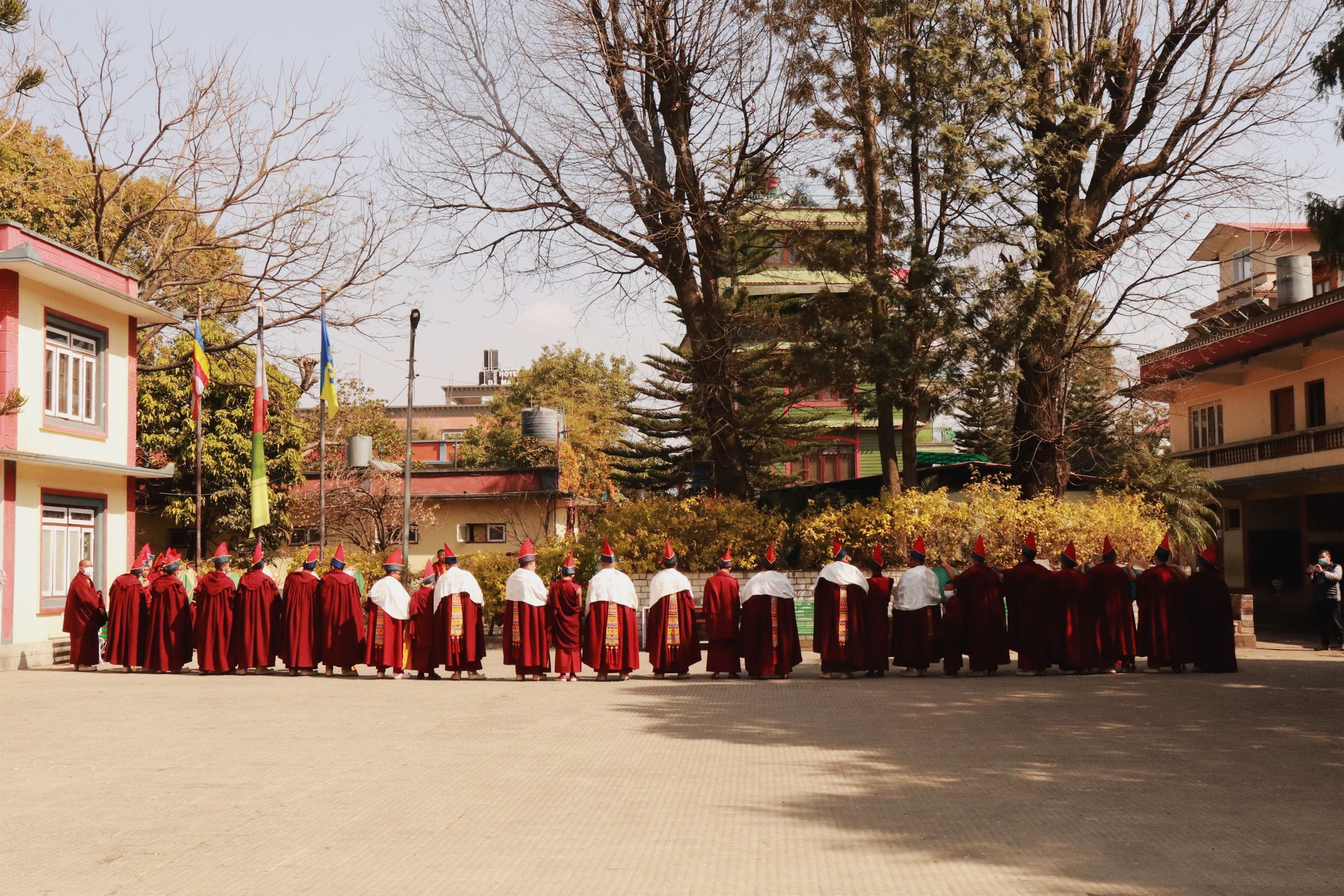 Monks assembled in the courtyard of a Himalayan monastery
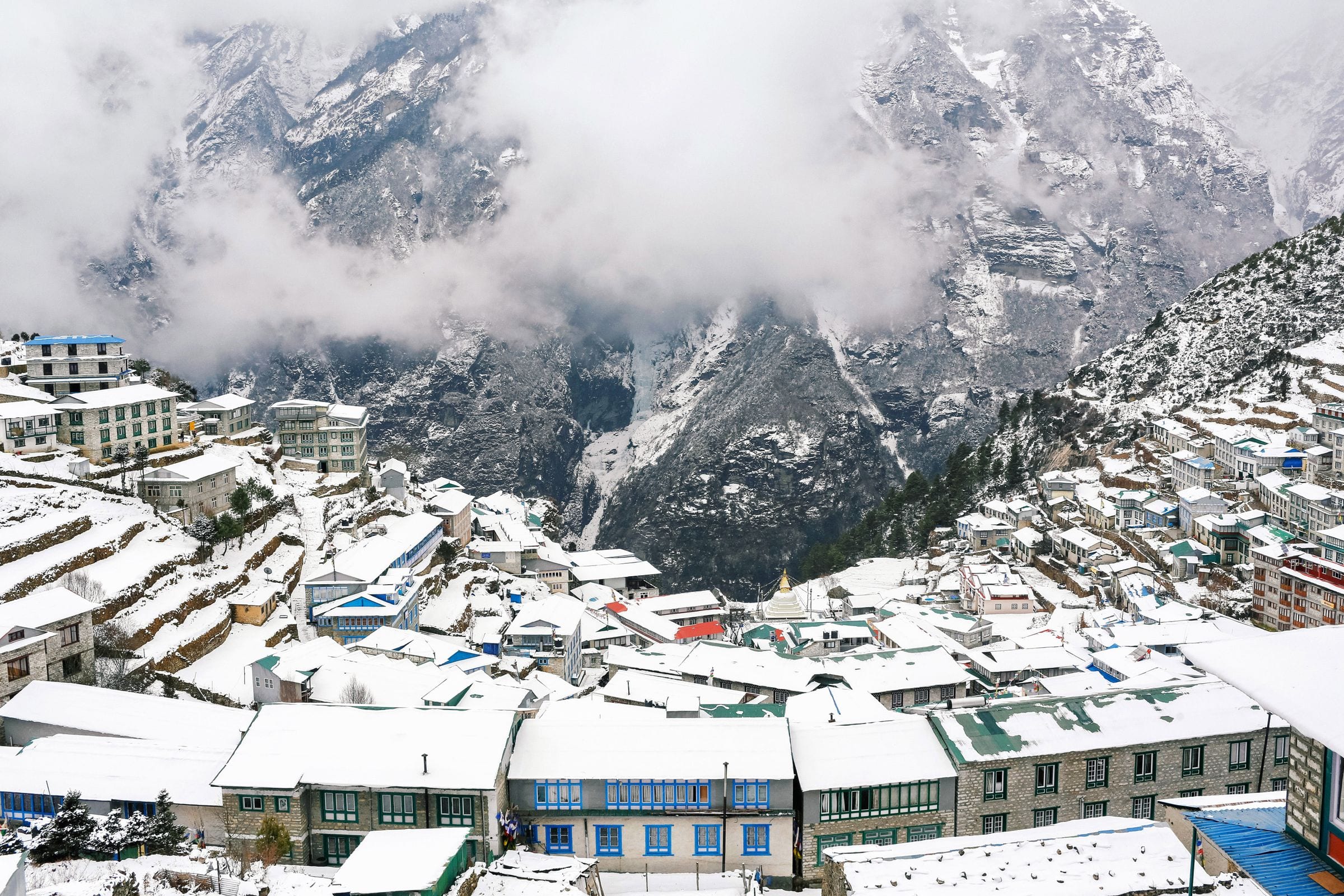 Namche Bazaar under fresh snow beneath cloud-covered peaks
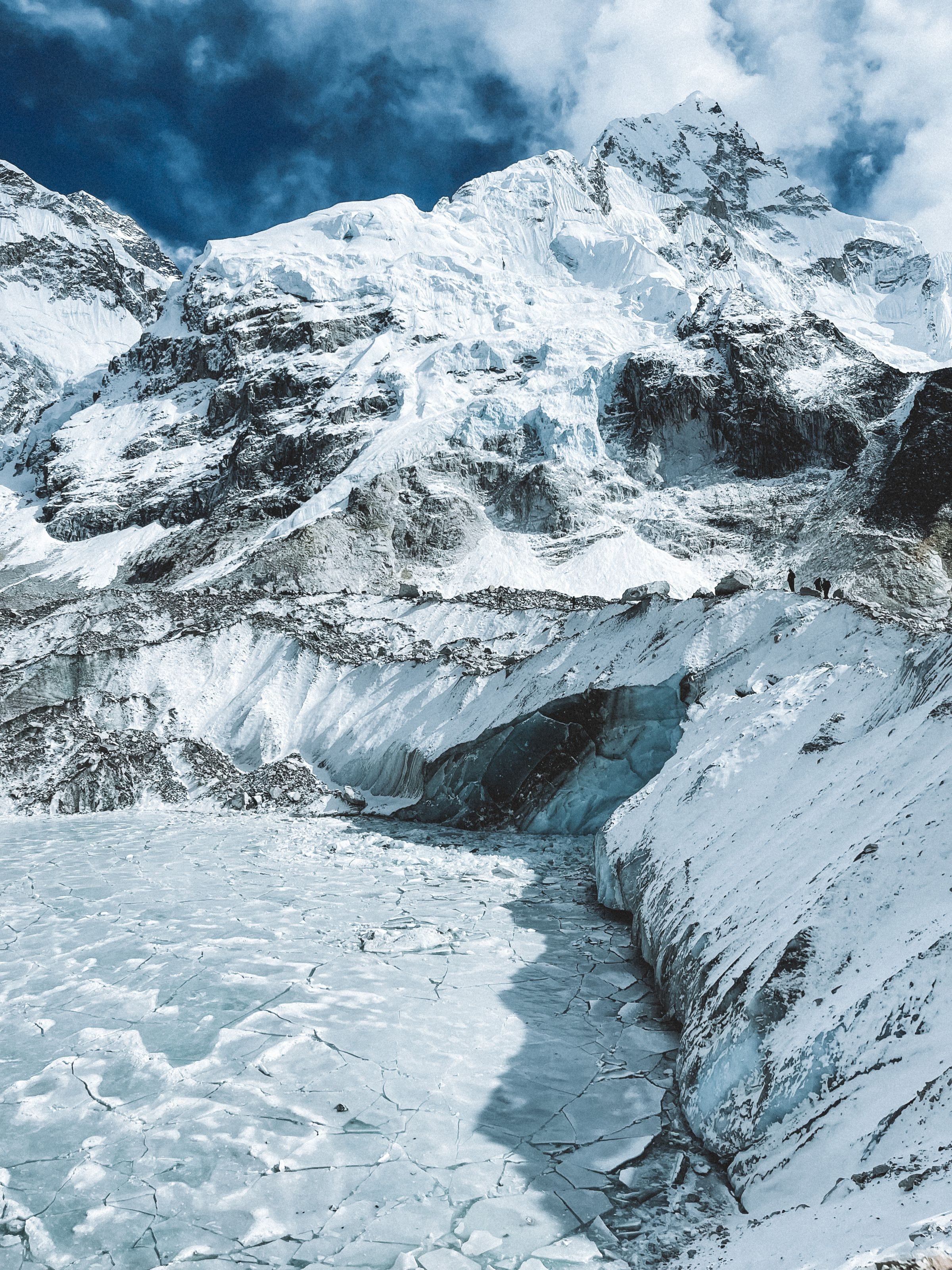 Frozen glacial ice and snow-covered rock high in the Khumbu
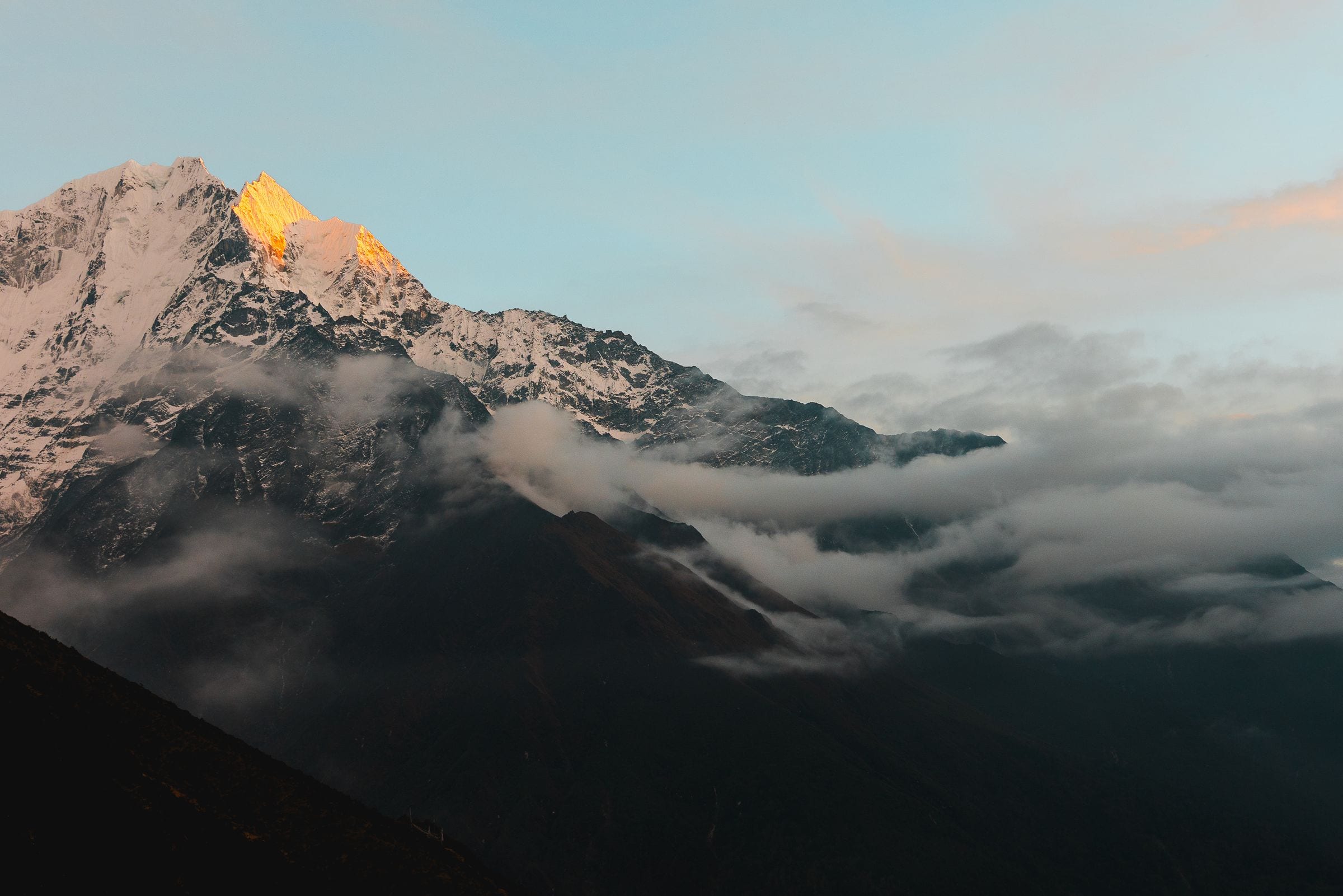 Sunrise light on Himalayan summits above a valley of cloud
Common questions
How fit do I need to be?
Fit enough to walk five to seven hours a day, on consecutive days, on rough ground. You do not need to be an athlete and you do not need technical skills: there is no rope, ice axe or exposure anywhere on this route. What catches people out is the repetition and the thin air, not any single climb. Three months of hill walking with a loaded daypack, twice a week, is the training we recommend.
What happens if the Lukla flight is cancelled?
It happens, most often in the afternoons and in poor visibility. We build a spare day into the Kathmandu end of the itinerary for exactly this. If the delay runs longer we will offer you a helicopter seat at cost, or reroute the trek. We will always tell you what a change costs before you agree to it, never after.
Is altitude sickness likely, and what do you do about it?
Mild symptoms (headache, poor sleep, no appetite) are common above 4,000 m and normally pass. Serious altitude sickness is rare on a well-paced itinerary, which is why ours has two full acclimatisation days, and above Namche no night gains more than 550 m of sleeping altitude. Your guide takes an oximeter reading twice a day, carries a first-aid kit, and has the authority to send anyone down. Descent is the treatment, and it is never a negotiation.
Do I need previous trekking experience?
No. Roughly half of every group is on their first multi-day trek. Previous time at altitude helps you know how your own body responds, but it is not a requirement and it is not a predictor: very fit people get altitude sickness and unfit people sometimes do not.
What are the teahouses actually like?
Simple lodges run by local families. Up to Namche you get a private twin room, often en-suite, with a hot shower for a few hundred rupees. Higher up rooms are plywood-walled twins with shared toilets, and at Gorak Shep it is genuinely basic and genuinely cold. Dining rooms are heated in the evening by a stove and are where the whole trail gathers. We book every night ahead of you.
Can I charge a phone, and is there Wi-Fi?
Yes to both, for a fee that rises with altitude: roughly NPR 250–500 to charge a device and NPR 500–700 for a day of Wi-Fi at the top of the route. Bring a 20,000 mAh power bank and you can skip most of it. Ncell and NTC have patchy 4G as far as Dingboche; above that, Everest Link is the only option.
What if I have to turn back?
An assistant guide walks you down and stays with you, so the group does not lose their guide and you do not descend alone. That is the reason we carry a second licensed guide on every departure of eight or more. Unused nights are not refundable, but we will not charge you for the escort.
How much spare cash should I carry?
Budget USD 15–20 a day for showers, charging, Wi-Fi, snacks and drinks, plus tips. Namche has the last dependable ATM, so draw what you need there in rupees, because cards are not accepted on the trail and the exchange rates higher up are punishing.
Do I need a guide, or can I walk this independently?
A licensed guide is required inside the national park, and the checkpoints in the Khumbu check the licence rather than the intention. That is the rule, and it is also what we would do regardless. Your guide is born and raised in the Khumbu, carries both permits and the oximeter, has the beds booked ahead of you, and is the one person on the hill with the authority to overrule you about going down.
Which permits does the trek need, and are they in the price?
Two: the Sagarmatha National Park entry permit, checked at Monjo, and the Khumbu Pasang Lhamu Rural Municipality permit, checked on the way out of Lukla. The old TIMS card has not been used in this region since 2018. Both are inside the price on this page, bought before you arrive; your guide carries them and produces them at every post, so you never queue at a counter.
Does the Lukla flight leave from Kathmandu or from Ramechhap?
It depends on the month. In the peak windows — roughly mid-March to mid-May and late September through November — the aviation authority moves every Lukla flight to Manthali airport at Ramechhap, four to five hours east of Kathmandu by road, and the transfer leaves your hotel at around 1 am to make the morning flying window. Outside those windows the flight goes straight from Kathmandu. Either way the drive and the flight are in the price, and the airport changing is not a surcharge.
How much luggage can I bring, and who carries it?
The aircraft into Lukla allow 15 kg a passenger: 10 kg checked and 5 kg of hand luggage, and it is weighed at the desk. One porter carries for two trekkers, within the 20 kg IPPG limit, so pack a duffel of about 10 kg for the porter and a daypack of 5–7 kg you carry yourself with water, layers, camera and documents. Anything you do not need above Lukla stays locked in the store at your Kathmandu hotel.
What exactly does my insurance have to cover?
Trekking to the height of this itinerary — 5,545 m at Kala Patthar — and, listed separately in the policy, helicopter evacuation, mountain rescue, medical treatment and repatriation. Insurers usually sell that as a 6,000 m trekking band; a standard holiday policy does not reach it. We ask for the insurer, the policy number and the 24-hour emergency line before you fly, because a helicopter in the Khumbu lifts on a guarantee of payment, not on a promise.
How far is the walk, and how high does it get?
About 120 km on foot across 11 walking days, Lukla to Lukla. Namche is 3,440 m, Dingboche 4,410 m and Gorak Shep, the last settlement, 5,164 m. Base camp itself is 5,364 m, and Kala Patthar — the dawn climb the following morning, and the best view of Everest anywhere you can reach on two legs — is 5,545 m. Days run five to seven hours; the two acclimatisation days are shorter climbs that finish where they started.
Should I take Diamox?
Ask your own doctor before you fly. It is a prescription drug, it does not suit everyone, and it is a poor substitute for the thing that actually works, which is the pace of the itinerary. If it is prescribed, bring it, tell your guide you are taking it and keep drinking, because it is a diuretic. What it will not do is hide a problem: if symptoms get worse while you are on it, you still go down.
What is the food like, and can you handle a special diet?
You order from the teahouse menu rather than eat a set plate, and it is included: noodles, soups, potatoes, momos, porridge, eggs, pasta, and dal bhat, the Nepali staple, which comes with refills. Vegetarian, vegan and gluten-free are all straightforward. Above Namche we suggest everyone eats vegetarian anyway — meat is carried up unrefrigerated for days. Tell us about allergies when you book and your guide briefs each lodge ahead of you.
Can I fly out by helicopter instead of walking back?
Yes, and plenty do: a shared seat from Gorak Shep or Pheriche down to Lukla or Kathmandu, arranged through us at cost. Two things to know. It is weather-dependent, so never book a same-day international connection behind one. And it is a convenience flight, not a rescue, so your insurance will not pay for it unless your guide or a doctor calls it a medical evacuation. Flying up to skip the walk is a different matter: the acclimatisation is the trek, and we will not sell it.
When is the best time to go, and is winter possible?
Late September to the end of November is the most reliable window: settled air, sharp light, cold but manageable nights. March to May is the other, warmer and hazier, with rhododendron in flower below Tengboche. Winter walking is possible and the views are the clearest of the year, but Gorak Shep runs to around −15 °C at night, lodges thin out and the high passes are shut. Through the monsoon, June to early September, expect cloud on the peaks and a flight schedule that comes apart.
Still deciding? The people who answer are the people who run the trek. Ask us anything: fitness, insurance, kit, or whether your dates are a sensible idea.
Message a trek specialistTravellers who walked this also looked at these
Same crews, same altitude planning, same published profiles: a step up, a step down, or the trek to add on the end.
StrenuousStrenuous7–9 hours a day · Above 5,000 m, with a passRemote routes, a high pass to cross on a fixed day, and camping where there are no lodges. Previous multi-day trekking at altitude is a condition of joining. StrenuousStrenuous7–9 hours a day · Above 5,000 m, with a passRemote routes, a high pass to cross on a fixed day, and camping where there are no lodges. Previous multi-day trekking at altitude is a condition of joining.
 ModerateModerate5–6 hours a day · 3,500–4,500 mLonger days with real ascent, and at least one acclimatisation day built in. Some training helps; hill walking most weekends for two months is enough.
 ModerateModerate5–6 hours a day · 3,500–4,500 mLonger days with real ascent, and at least one acclimatisation day built in. Some training helps; hill walking most weekends for two months is enough.